Trascrizione
We have reached a series of rooms that have been refurbished several times over the course of history and what we see now dates to work carried out in 1549, for the marriage of Francesco III Gonzaga to Catherine of Austria.
The first room is called the Sala dei Soli, with its dual depiction of the radiant sun – the emblem of the Gonzaga family – located in the centre of the vault and decorated with a foliage motif. From here we enter the central room, its barrel vault decorated with a faux architectural frame in which there is a black stone (“paragone” in Italian) portal, and also with foliage motifs. The next room is called Sala delle Cappe, referring to the old Italian word for shells and here indicating the elements depicted above the cornice. If we glance upwards, we see medallions dedicated to the four Elements.
The works exhibited in these rooms are part of the Romano Freddi collection. This Mantua businessman recovered Gonzaga family traditions and revealed the sheer scale of the family’s legacy, bringing together items from different eras and genres in Mantua, including paintings, pottery, sculptures, and weapons. Of all the pieces in the collection, two works closely connected to the Gonzaga family are worthy of note: the first is a panel painting – Jupiter, Neptune and Pluto Sharing the Three Kingdoms – executed to a drawing by Giulio Romano, part of a series probably intended for the Appartamento di Troia in Palazzo Ducale; the second is the portrait of Francesco IV Gonzaga, eldest son of Duke Vincenzo I, a fragment of the impressive Holy Trinity altarpiece by Pieter Paul Rubens, now exhibited in Salone degli Arcieri, in Palazzo Ducale.
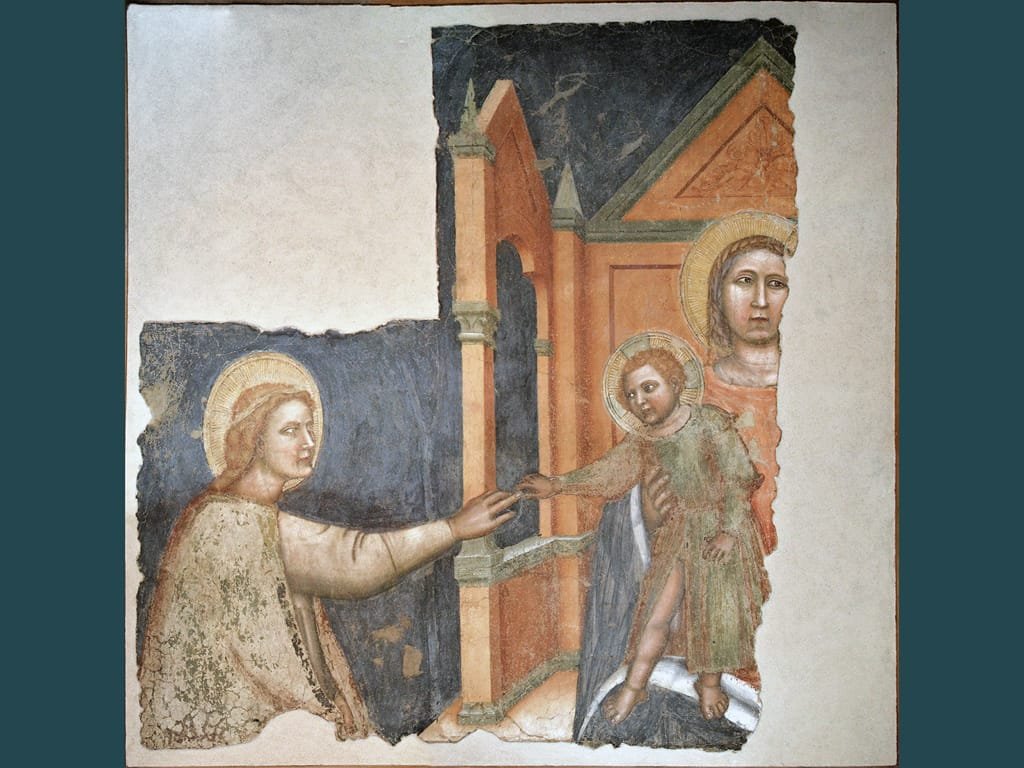
The collection includes the remarkable Mystical Marriage of Saint Catherine, part of a fresco that decorated the fourteenth-century Bonacolsi chapel, remodelled by the Gonzagas after they took power in 1328.
From the Sala delle Cappe we enter the Sala della Grotta and Isabella d’Este’s Studiolo, created in the 1490s. The study was intended to be a private space, an intellectual retreat, but became famous for hosting the marquise’s precious art and antiques collections, considered a cultural reference for Italian and European courts even at the time.