Trascrizione
The tapestries designed by Raphael that you are viewing here combine the ideals of Italian Renaissance culture with prestigious Flemish technical expertise. One of the finest expressions of 1500s’ figurative culture, this type of textile art came mainly from the Flanders town of Arras.
The manufacture of tapestries was particularly laborious and slow, not to mention the amount of time required to bring them to destination. The Mantua series was woven in Brussels by three artists, Jan van Tieghem, Frans Ghieteels, and a third master whose name is not known and is called the “Master of the Geometric Mark”.
Although very refined, their woven wool and silk is not the best quality achieved by these tapestry makers, who sometimes even made use of silver and gold yarns.
The second room of tapestries welcomes you on the left with the Fall of Saul on the Road to Damascus, in the centre the Sermon of Saint Paul on Areopagus, and on the right, Christ Giving the Keys to Saint Peter.
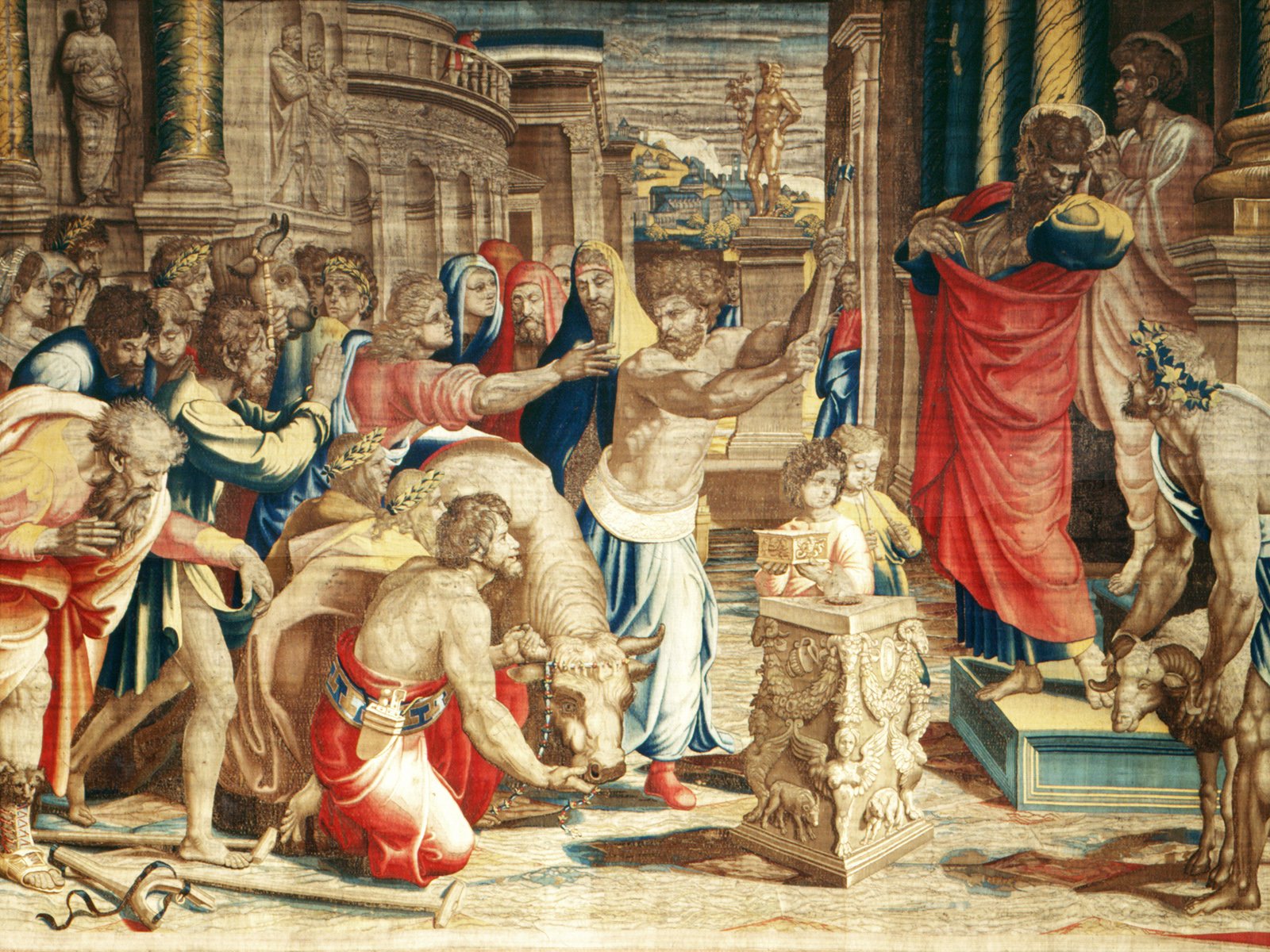
The third room, the Sala delle Imperatrici, has the Death of Ananias on the entrance wall; on the wall opposite the window the Sacrifice of Listeria, while on the wall opposite the entrance you will find the Healing of the Lame Man, beautifully framed by the spatial layout of barley-stick columns in perspective.
It was no accident that Cardinal Ercole Gonzaga purchased a series of tapestries, replicas of those in the Sistine Chapel. In point of fact, in the mid-sixteenth century, Ercole aspired to become pope but he was thwarted by a handful of votes at the 1559 council.