Trascrizione
The first hall is dedicated to the need to measure and face the reality of climate change, which connects the long research tradition carried out in Padua and the pressing relevance of global warming. The four corners of the room, like the four elements to which they refer, focus on different themes, though connected among themselves and with the central globe: this invites us to grasp the planetary dimension of the phenomenon, a problem that affects all the inhabitants of the Earth. The aim of the room, as suggested by the large circular mirror that overlooks the globe, is to make us reflect on the risks facing us and, at the same time, to make us aware of our responsibilities concerning greenhouse gas emissions such as CO2. The circular infographic display at the base of the globe quantifies these facts by showing the percentage of emissions released by the main economic activities.
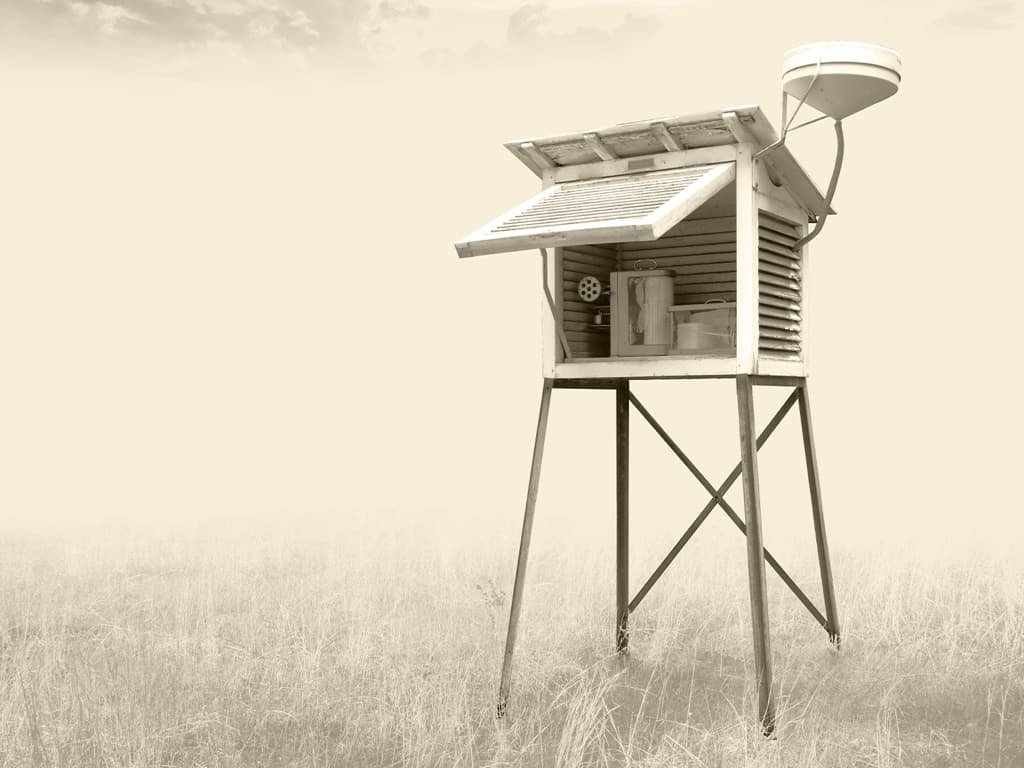
The hall is dedicated to the first professor to occupy the chair of Physical geography at the University of Padua in 1904: this was Luigi De Marchi from Milan, whose studies in the field of climatology took him to promote the first international commission for the study of climate change in historical times in 1926, which would be the precursor to the current Intergovernmental Panel on Climate Change. In the corner dedicated to Air, you will find the manuscript of the “Climate” entry of the Italian Encyclopaedia, which he wrote in 1932. In the corner you can also find tools which the geographers used to measure meteorological phenomena. They date back to the 1960s, when Padua was the seat of the CNR Study Centre for Physical Geography.
The sunshine recorder is certainly one of the most inquisitive and lesser-known instruments, which uses a glass sphere and a photosensitive card to record the daily sunshine duration; while the baro-thermo-hygrograph uses horsehair for measuring air moisture content. You can test yourself and try to guess which phenomenon these instruments measure by means of the interactive screen.
Unlike meteorology, the study of climate requires a long series of measurements, like those obtained by the international scientific community in Antarctica, which also included researchers from Padua between 1988 and 2000. In this context, as can be seen on the transparent cylinder on the central display, the study of an ice core over 3000 metres long allowed us to learn that today, for the first time in the last 800,000 years, the threshold of 400 parts per million of CO2. in the atmosphere has been exceeded.
Changes have always been part of the history of the climate, as shown in the Map of Italy during the Quaternary Age by Bruno Castiglioni. However, the high concentration of CO2 and of other greenhouse gases is now accelerating warming and increasing risks of serious damage to human territorial organization. So, in the map which shows the worst possible scenario and represents Italy in the aftermath of the melting of all ice caps on our planet, our plains are submerged by dozens of metres of water, with the surface of our country reduced by over 20%.
The observation and measurement of glaciers is strategic to understanding the current evolution and predicting future developments. In the corner dedicated to Water, a large-scale 3D model shows the retreat of the Marmolada glacier, the most important in the Dolomites Mountain range and one of the most studied in the Alps, that in the last century has seen its surface overall reduced by 75%.
The long season of glaciological research has left us with several tools used to measure the frontal retreat and mass balance of glaciers; together with numerous photographs that consent a merciless comparison between the images taken in the 1920s by Bruno Castiglioni and ones taken recently.
In the third corner, dedicated to Earth, the research in physical geography intersects with the social, cultural, and economic reflections of the geographers of our department. Some of these voices have been collected for you in short video interviews that you can start up independently by using the buttons under the curved screen. Above, the large planisphere shows the variable vulnerability to climate change of different areas of the world, allowing us to anchor the theme of cause and effects to that of human organisation of space.
As the words of Pope Francesco recall, we must consider the climate and ecological issue in a broader and more dramatic social context.
The fourth and last corner aims at provoking you. Have you ever thought of how many planets we would need if everyone on Earth adopted the lifestyle of an inhabitant of Australia? Or that of an inhabitant of India? Or of an average Italian? Today, the world population exploits the resources produced by the equivalent of almost two and a half planets, exhausting yearly supplies by the summer and therefore systematically affecting the resources needed in the following years and future generations.
In order to reduce our consumption and postpone the Overshoot Day for as long as possible, each of us can make a difference: explore the drawers and small doors on the wall and discover 15 concrete actions by which you can do your part. With this new awareness you can now continue your visit by entering the next room behind you.