Trascrizione
The large hall is a stunning and luminous space where sunlight breaks in through the large stained-glass windows overlooking Via del Santo and reflecting off the mirrors on the opposite side of the room. Here an echo recites the stories of time. For example, in this palace Leone Wollemborg was born in 1859. Renowned economist and politician of great moral stature, he established the first Italian Rural Bank at just 24 years old.
The hall maintains the appearance it had at the time of the Wollemborgs, with its neoclassical layout enlivened by the liberty glow of the fireplace and the window. Made in a white-painted wood that imitates marble, they are a typical example of the eclectic style of Gino Coppedè, the well-known architect who gave his name to a neighborhood in Rome and whose career started right here, at Palazzo Wollemborg.
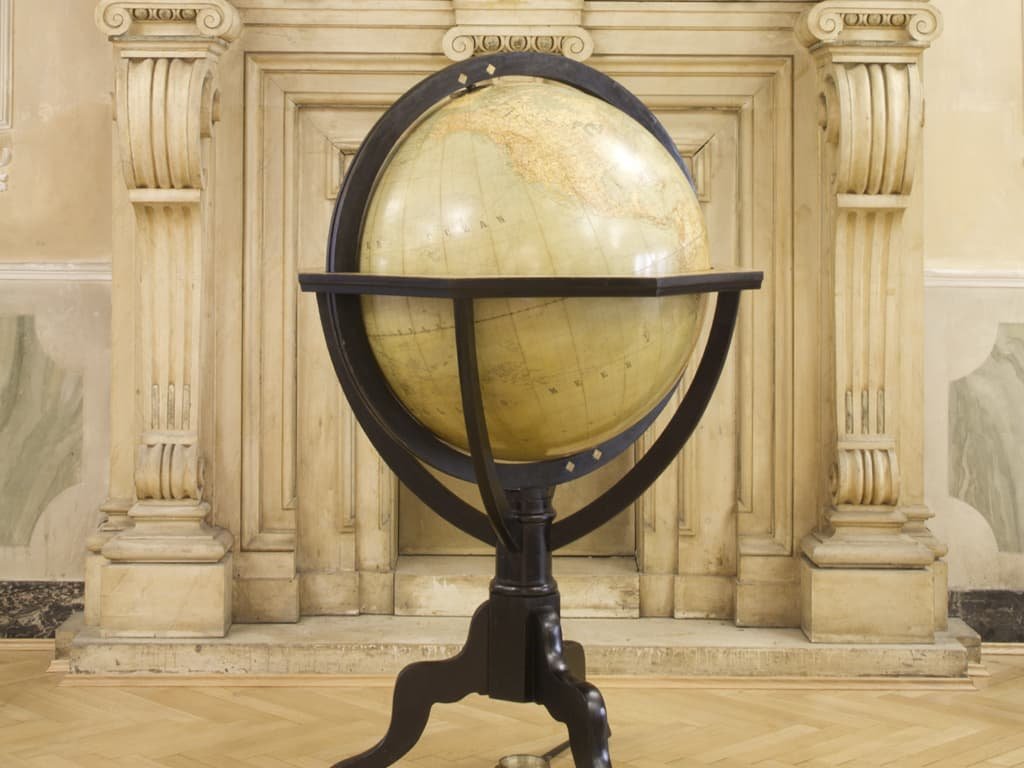
Since 1972 Palazzo Wollemborg hosts Paduan geographers. Exactly one hundred years before, the first chair of Geography was established at the University of Padua, which is among the oldest in Italy. Throughout this long history, geographers have collected a rich and varied heritage, consisting of 3000 maps, 150 measuring tools, 8 globes, 110 atlases, 34 relief models and more than 20,000 photographs. In front of the entrance to the museum, a terrestrial globe, perhaps the most emblematic geographical object, is there to welcome you. It was made in Berlin at the beginning of the twentieth century and is characterized by a three-dimensional representation of the relief, by means of painted plaster, a fragile material that explains the rarity of this type of globes.
The two photos on the walls recall the fact that Paduan Geography has always been characterized by the combination of the physical and human approaches to the discipline: the first image refers to the role of human work in the modeling of landscape, the second to glacier fluctuations, subject of several physical geography studies.
The “binary” logo of the Museum, modeled on the old representations of the Earth in two hemispheres, also refers to this fruitful collaboration.
You will learn more about the geographical heritage and research in Padua along the three exhibition halls, each dedicated to one of the three museum keywords: Explore, Measure, Tell. To continue, enter the first Hall through the door between the mirrors.