Trascrizione
Let’s now discover Poleni's restoration work on St Peter's dome in Rome. Poleni was invited to work on the dome by the pope of the time, Benedict XIV, in 1743.
The pope's concern was such that, as he himself wrote, 'as we saw the Marquis Poleni, it seemed to us to see who, with the help of God, will hold up the threatened Vatican Dome'.
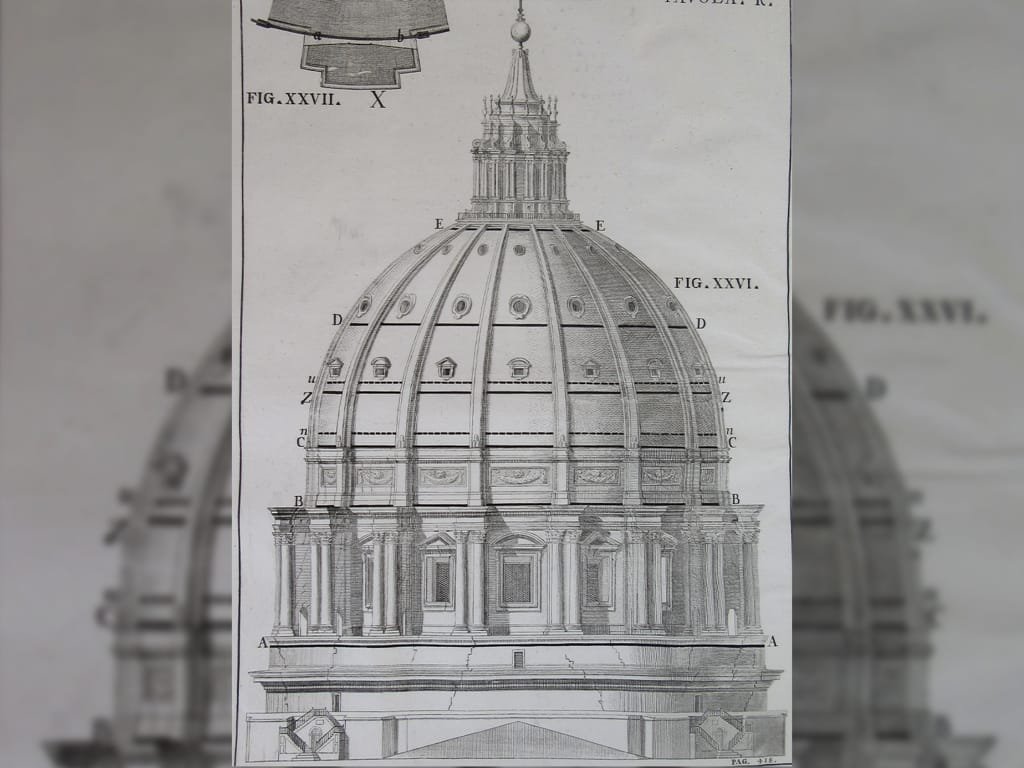
Thanks to his profound knowledge of experimentation and ancient architecture, Poleni conducted careful studies. He analysed every crack, as shown on the print on the wall on the right. The print is taken from the volume that Poleni dedicated to the restoration of the dome.... Note that the volume itself is exposed, behind the machine, on the platform…
Poleni decided to fill the cracks with suitable materials and to fix iron rings to the dome. You can see the iron rings fixed to the dome in bold black on the large print in the background, behind the big machine on display… In order to determine the section of these rings, Poleni actually used this large machine, which allowed him to study the strength of a piece of iron. The piece of iron was fixed vertically behind the upright and connected to the horizontal steelyard. The weight was then moved along the steelyard until the piece of iron broke.
The architect Luigi Vanvitelli, under the guidance of Poleni, physically carried out the restoration work in Rome. Let’s underline that the Pope himself went to St Peter's Square, in a rainy day, to bless the first ring before it was installed.
Now enter the room on the right, dedicated to optics.
You will immediately find numerous 18th-century instruments. On the left, first of all, drawings and oil paintings with their mirrors, which allowed various optical illusions. These were classic elements in 18th-century physics lectures. Have a look at the chest of drawers behind you: the distorted images that appear on the screen are correct if you look at them in the cylindrical mirror. If you try to open the drawers, you will find the 18th-century original aquarelles…
Let us now return to the entrance of the room: you have mirrors and lenses - if you wish, just take a look at yourself in the large concave mirror from different distances! …
In the showcase close to the chest of drawers, you will find devices in which the laws of optics are applied, such as a telescope and a camera obscura. How does a camera obscura work? We have known since Greek antiquity that by making a small hole in the wall of a dark room, objects placed outside appear to be projected upside down inside the room. We owe the first in-depth study of the camera obscura around the year 1000 to the scientist Alhazen. The use of the camera obscura to observe landscapes has been documented since the Renaissance, and several artists, including Canaletto, used this device in their work.
Continuing into the room, in the showcase on the right, there is a prism, and then a splendid collection of 18th-century glass slides meant to be used with the magic lantern in front of you… The images projected correspond to what students or the public could see in the 18th century!
A few steps forward, in the opposite corner, don't miss the heliostat of Antonio Tessarolo, son of the mechanic of Padua Cabinet of Physics. By means of a mirror, the instrument projected the light of the Sun into a room to allow optical experiments. It was necessary to follow the apparent movement of the star, hence a refined clockwork system. This is a unique instrument. Although rich in potential, the device actually remained a prototype in a region where, as you have already seen, there was a lack of workshops that could develop and disseminate new inventions.
The following showcases tell us how the 19th century brought clamorous innovations to the field of optics, such as the wave theory of light, polarisation and photography. Spectroscopy, whose instrumentation you can see in the corner showcase on your left, also emerged as a new research field: each chemical element emits or absorbs light according to specific colours, and the chemical composition of remote bodies, such as stars, can thus be studied.
Note also, in the display case to your right, a stereoscope and a polystereoscope for 3D vision: instruments for studying perception and optical illusions were also becoming widespread in those years. This contributed to the birth of experimental psychology. Yet one more link between physics and another discipline!
Let’s now go with the visit, retrace our steps and go down the stairs…
You are passing by the display dedicated to experimental acoustics. We will not linger but observe, in the last case, a phonograph…Patented by Edison in 1877, it is the first device for recording and reproducing sound. The model on display was one of the very first, presented at the Universal Exhibition in Paris in 1878.
Now go back towards the Museum’s entrance. After the map, you will find on the left the last room to be visited, which deals with Modern Physics.