Trascrizione
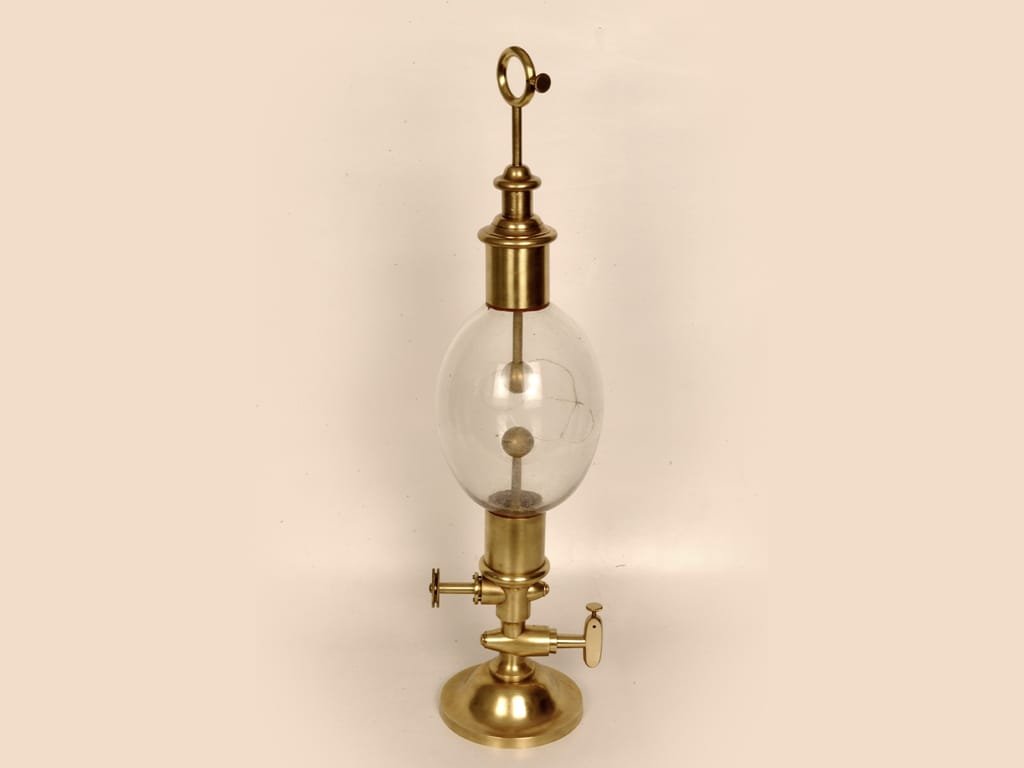
First turn to the wooden showcase on your left. Here, in the foreground, we see an egg-shaped container, a so called 'electric egg'. What happens if an electric discharge passes through it? If the gas in the container is rarefied, we see coloured glows, like those you see in the two tubes that lit up on your right. The colour and shape of the glows depend on the gas contained and on the internal pressure.
Also in the showcase on the left, please notice a 19th-century print of an aurora borealis: because of their similarity to the colours of the northern lights, discharge tubes were also called 'aurora tubes'.
Discovered in the late 17th century, these spectacular phenomena were studied for a long time without much success. However, Geissler's and Crookes' tubes - which you can see in the left and centre showcases - tell us that electrical discharges in rarefied gases became one of the leading areas of physics in the mid-19th century, thanks to higher vacuum levels and higher voltages. The term 'cathode rays' was introduced, but the debate on the nature of these phenomena - are they waves or corpuscles? - remained open for a long time. As you can see in the display case on the right, these researches eventually led to the discovery of X-rays (in 1895), radioactivity (a few months later, in 1896), the electron (in 1897) and to applications such as neon tubes and... television.
Electric discharges in rarefied gases were therefore a field that did not yield important results for almost 150 years, but which then opened the door to modern physics and brought remarkable technological applications. So what do these instruments tell us? That it is not always possible to foresee the development and applications of a field of research... Of course, politicians tend to fund sectors that are immediately conducive to applications... But does it make sense to distinguish between applied physics and fundamental physics? Here is quite a cutting-edge issue that is worth reflection.
In Padua, the then professor of physics at the university, Giuseppe Vicentini, immediately began to produce and study X-rays, as you can see from the extraordinary collection of X-ray plates in front of you. It's like entering a physics laboratory at the end of the 19th century! Vicentini immediately introduced X-rays to his students and used them for medical purposes in collaboration with a local clinic: Padua radiology was born. Note that these X-rays plates were obtained a few weeks or months after the discovery of X-rays.
But how were X rays produced at the end of the 19th century? You can discover it by means of the instruments on display. On the left is a battery, connected to a transformer - in this case an induction coil - and finally the discharge tube - here is one of the very first, dating from 1896.
Now leave the room and head for the corridor.