Trascrizione
Here we are now in the sections dedicated to the study of heat, on the left, and meteorology on the right.
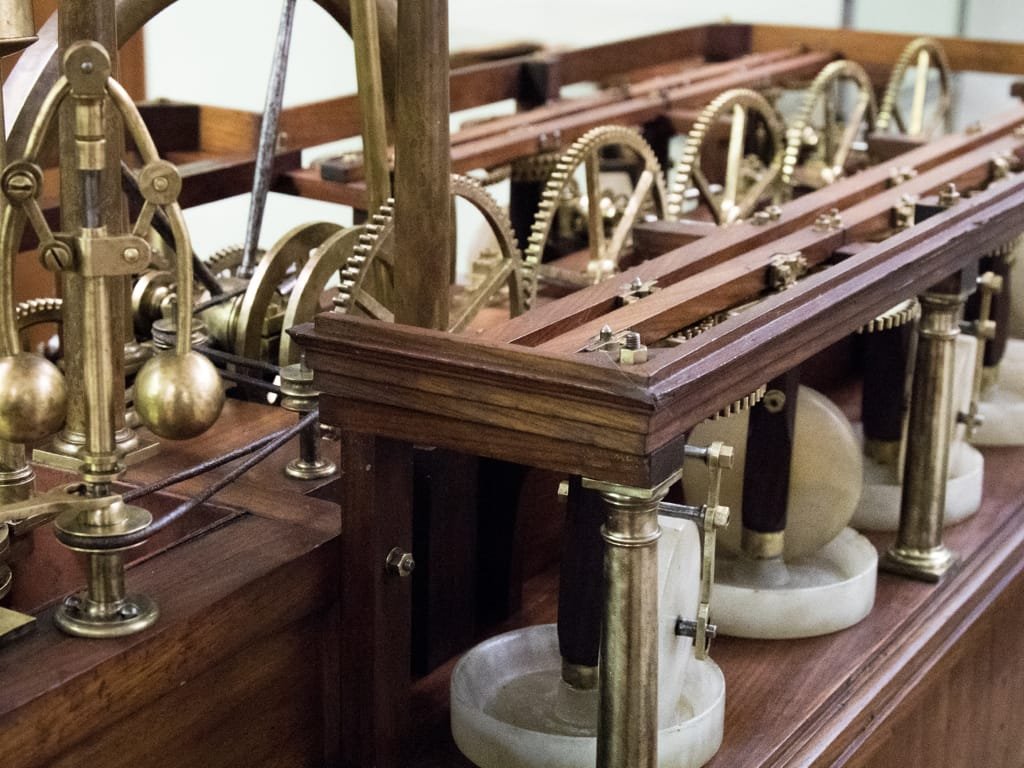
First of all, the instrument in front of you is a model of a steam engine used to prepare tobacco. You can see the alabaster wheels for crushing the tobacco and, at the back, the rollers that pressed the leaves. The steam, produced in the boiler on the left, set the machine in motion: the steam was injected alternately above and below into the cylinder, thus driving the internal piston, and the motion of the piston was transmitted to all the gears. The machine incorporates several improvements introduced in the 1760s-80s by James Watt, including the centrifugal regulator (with two spheres), which you see on the front. These innovations determined the success of steam engines, thus contributing to the development of the industrial revolution.
This machine was meant for Venice tobacco manufacture, which you can see in the print at the top left. The model was designed and built in Milan, and won a medal at the industrial awards of the Lombard-Venetian Kingdom in 1822. A similar machine was successfully used in France to bring water to the park of Versailles. However, the machine based on this model was never built in Venice, as the Austrian government was not very interested in technological innovations. In 1826, the Emperor of Austria gave this model to the Padua Cabinet of Physics as a gift, and it thus became a teaching tool… Can we say it was a failure? Examples like this show how delicate it is to define “success” and “failure” in science and technology, given the importance of the political, social and economic context - in short, success also depends on funding, and on favourable political and social conditions...
We should now turn around and take a quick look at the first showcase. We will not dwell on many other instruments used to study heat, but let’s focus on the lower showcase on the left: here we see an enlarged signature. It is the signature of Angelo Bellani, a scientist and instrument-maker from Monza, who devoted himself to studies on heat and meteorology. This signature, which is on one of the thermometers in the showcase, shows us the friendship between Bellani and Salvatore Dal Negro, the professor of physics in Padua in the early part of the 19th century. This is another example of the variety of stories that the Museum's instruments can tell us: stories not only about the scientific exchanges between local physicists and the rest of the scientific community, but also stories of friendship.
Let us now turn our attention to the left, to the wall showcase dedicated to meteorology. On the right you see a thermometer displayed alone in the showcase: it is unique in the world, like many other instruments in the Museum. If you look at it closely, you will see that there are eight different thermometric scales: Newton's scale, Réaumur's scale, etc. In the 18th century, there were actually many thermometric scales in use, due to the ongoing "race" to find what we can call a "standard thermometer", reliable and easily reproducible. Reliable fixed points were sought - for example, the melting temperature of ice was examined, but also the melting point of wax or butter... Various liquids were tried, from alcohol to mercury, to olive oil... The result was a multitude of different thermometric scales: in the adjacent showcase, you can see 15 of these in the top print and 27 in the one below.... - one of the scales was actually due to Poleni! And beware: studying these scales and historical thermometers is crucial today for analysing climate change: if you examine temperature measurements from the past, you need to know on which thermometer they were taken and what scale was used. Historical thermometers have become crucial today in cutting-edge issues!
(Continue along the showcase to the next section).