Trascrizione
The room of the plaster cast collection contains casts aimed at teaching of classical sculpture.
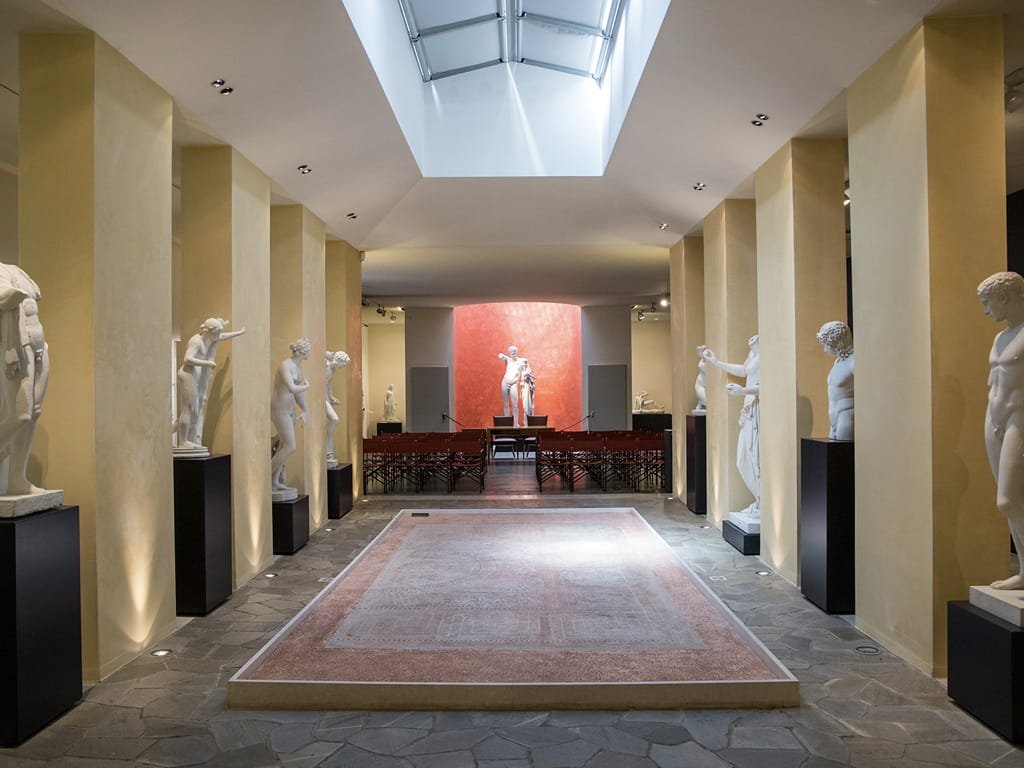
Observe the space that houses the plaster cast collection: it is arranged around a central structure with a ground basin and an opening in the ceiling. It recalls the impluvium that was a structure at the entrance, the so-called atrium, of the Roman stately homes, the domus. Behind the impluvium you see a large red hemicycle: from this point you can see the entrance room and the staircase that is at the opposite end of the museum. On the sides of the impluvium you see a series of yellow pillars beyond which runs a second exhibition space bordered in turn by walls and by an equipped wall that separates the exhibition from the transit area, with windows. This complex arrangement of spaces, full of references to Roman antiquity, is part of Gio Ponti's original project for the museum and it was brought back to light thanks to the restoration and the new layout of the interiors made in the early 2000s. About these restorations, you will find information in the video station located along the corridor with windows. In the same station you can also find a second video, relating to the history of the collection.
The visit route of the plaster casts gallery is arranged in chronological order. The captions next to each cast identify: the subject and the museum in which the original work is currently located. Along the way you can take advantage of 3 information points with in-depth cards, in addition to the video station. The exhibition includes a central area, dedicated to full-length reproductions of the major masterpieces of classical Greek and Roman sculpture and then a chronological itinerary that develops counterclockwise around the central area. Starting from the latter, the plasters display here uses the spaces between the pillars of the impluvium, creating a series of characters in dialogue with each other and with the architecture. Recognize some very famous statues such as the Medici Aphrodite and the Dancing Satyr of the Uffizi in Florence, the Apollo “sauròcton” or hitting a lizard from Villa Albani in Rome, the Aphrodite of Arles now in the Louvre Museum in Paris. In the large hemicycle, the plaster in real size of the statue of Hermes with the child Dyonisus, found in Olympia in Greece and preserved there, stands out. The sculpture looks towards the basin of the impluvium which originally contained water: the space now houses about half of a Roman floor, found during the excavation for building the Liviano palace in 1936.
The path that runs counterclockwise around the impluvium is organized into four chronological stages, positioned in the four corners of the room and dedicated respectively to Archaic Greek art, to Classical Greek art, to the Hellenistic period and finally to Roman art. Leaving the impluvium behind, you will find on your right the first stage, archaic Greek art (seventh century -first half of fifth century B.C.) with three casts of Greek sculptures from the sixth century. B.C. and the cast of a Roman copy of the lost Greek original of the Discobolus, that is to say the discus thrower, by Miron (460 B.C.). On your left, beyond the passage, you will find the second stage, the classical Greek art (mid fifth century BC - 323 BC) the largest: the predilection for the statuary of this period prevailed for a long time in classical archaeology. First of all you will find a space dedicated to the great sculptor Pheidias with the Palagi head known also as Athena Lemnia, and some slabs of the frieze and pedimental sculptures from the Parthenon temple in Athens. The route continues along the gallery on the right side of the impluvium, bordered by a long dark-coloured wall, commissioned by Gio Ponti to bring out the whiteness of the plaster casts. It contains casts from reliefs and sculptures in the round taken from originals or copies of Greek works dated to the fifth and fourth century B.C., made by Attic workshops but also abroad. On the wall you will find, among the reliefs, the winged victory from the temple of Athena Nike over the Acropolis of Athens and the funerary stela called “of Ilyssos”, work of an Attic workshop influenced by the sculptor Skopas from Paros. On the shelves and along the same wall there are busts including the Zeus of Otricoli, the Farnese Iuno, the Capitoline Aphrodite, and a Poseidon from the Vatican Museums: they are often partial reproductions, only of the portrait, compared to the whole statues preserved in the museums mentioned above. Once the shelves are finished, the sculptures continue along the wall and there are some casts of busts including that of Eros loosening the arch, copy from Lysippus, as well as the cast of the only head of the Farnese Hercules, known through Roman copies. Another partial cast is that of the Apollo of Belvedere in the Vatican Museums, a Hellenistic copy of an original from the end of the fouth century B.C. attributed to Leòchares. The work was greatly admired in the past centuries for the opinion that Johann Joachim Winckelmann gave on it in his History of the art of antiquity, published in 1763, a work that marks the beginning of the history of classical art.