Trascrizione
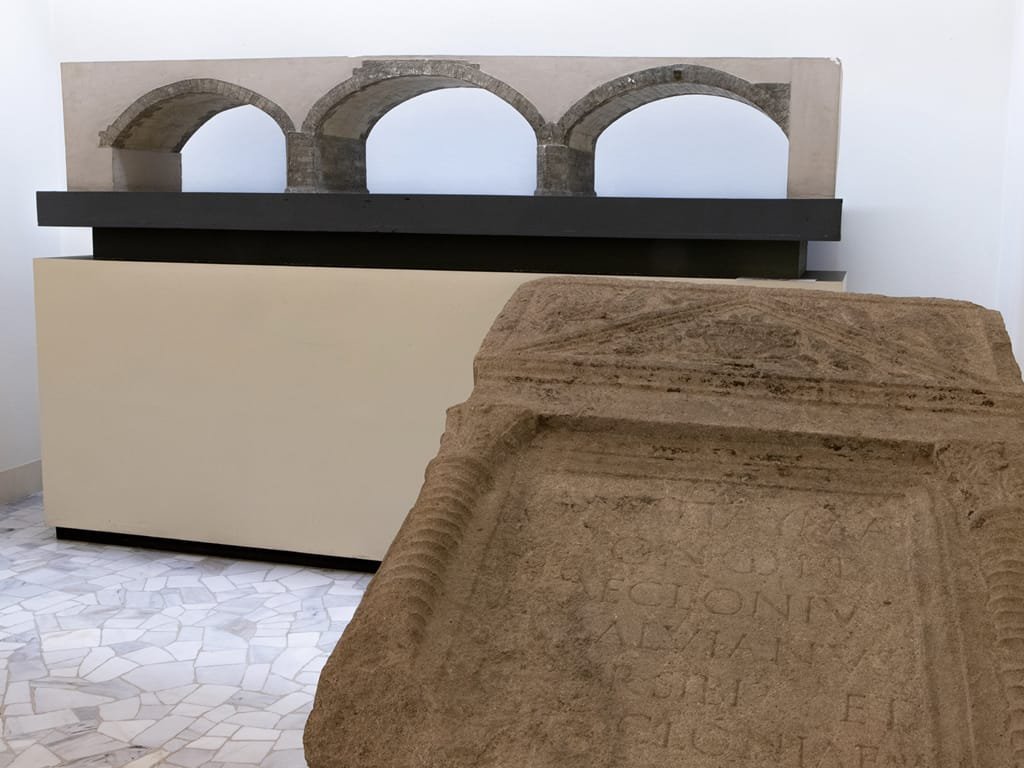
In the rooms nn. 9, 10 and 12 there is the last archaeological section of the Museum, dedicated to the Roman world. Looking at the finds, you will realize how much of the history of Roman Padua, Patàvium, has part in this display: along the back wall of room 9 you will notice the model of one of the best preserved Roman monuments in the city, the bridge of San Lorenzo. Although never completely buried since Roman times, the bridge came to light completely only in 1938 with the construction of the new wing of the Central Palace of the University, ordered by Carlo Anti. It was probably the same Anti who commissioned for this museum a model that celebrated and documented, with educational purposes, the rediscovery of the bridge, reproduced in 1:20 scale with every abundance of details. On the central arch you can see the inscription that dates the bridge between forties and thirties B.C.. In front of the model, on left, you will find a fragment of the marble parapet of the same bridge of San Lorenzo, also found in the excavations of 1938, which bears the name of its financier, Allenius Strabo, a character who in the Augustan age held various public offices in Patàvium. On right you can instead appreciate a funerary stela, coming from the territory of Roman Padua, which recalls the deceased Pùblius Meclònius Salviànus, datable between the first and second century A.D.
On the opposite side of the corridor, in room 10, you will meet other items from the excavations for the expansion of the Bo Palace, especially the amphorae arranged along the side wall which date to the middle of the first century B.C. and were part of a land drainage system along the right bank of the urban river port. In the showcase is also preserved a bronze statuette of Mercury that most likely refers to a private cult in the same area. In general, the room where you are in is dedicated to objects of everyday roman life. To represent the private religion, in addition to the bronze of Mercury, there are other bronzes, variously datable between the late Republican age and the full imperial age and representing deities, bidders or anatomical parts. Among the other objects on display, in the left part of the showcase observe a large group of lamps: datable along the entire wide arch that from the late Republican age goes up to the advanced imperial age, they refer to some of the main types known for the Roman world, among which certainly stand out those characterized by ornamental motifs alongside the beak, datable between the late Augustan age and the Flavian age, and the so-called Firmalampen, almost always characterized by the presence of the trademark on the bottom and especially widespread in northern Italy and in the northern provinces of the Roman empire until the fourth century A.D. In the central column of the showcase, you will find exposed fine tableware, especially the so-called terra sigillata, Roman vases characterized by the red colour of the surface, a relief decoration and, also in this case, by the frequent presence of trademarks. The most represented ware productions are the Gallic and the North-Italic ones; to the first production, clearly distinguishable for its bright red colour and for the rich relief decorations, also belongs a fragment of a mold dated to Trajan-Antonìne age. There are also several bronze objects of daily use, including an element of steelyard, probably from Herculaneum, as well as, on the right, the series of weights in polished black stone, characterized by the presence of points engraved on the surface, that are measurement indications. In the same right portion of the showcase, see some fragments of architectural elements, wall and floor decorations that refer to private buildings of the Imperial roman age.
The Roman section closes with room 12, where glass artifacts from several different museum collections are exhibited. The objects can be traced back on a typological basis to productions of both the western and eastern parts of the Roman empire and are datable within the wide chronological span that goes from the first to the fifth century A.D. Among the most represented forms there is undoubtedly that of the balsamarium, a small bottle used to store ointments, perfumes and rare oils. Although in fragments, of lesser interest aren’t the rods decorated with twisting that are located in the center of the showcase, at the bottom: widespread in all the territories of the empire between the first and second century A.D. they had to be intended to mix and apply cosmetic products.
In display, on the right, you will finally meet some examples of fakes: having become part of the private collections merged into the museum, these objects were frequently traded by antiques dealers of the past and purchased by collectors who, more or less aware of their counterfeiting, exhibited them alongside truly ancient artifacts.