Trascrizione
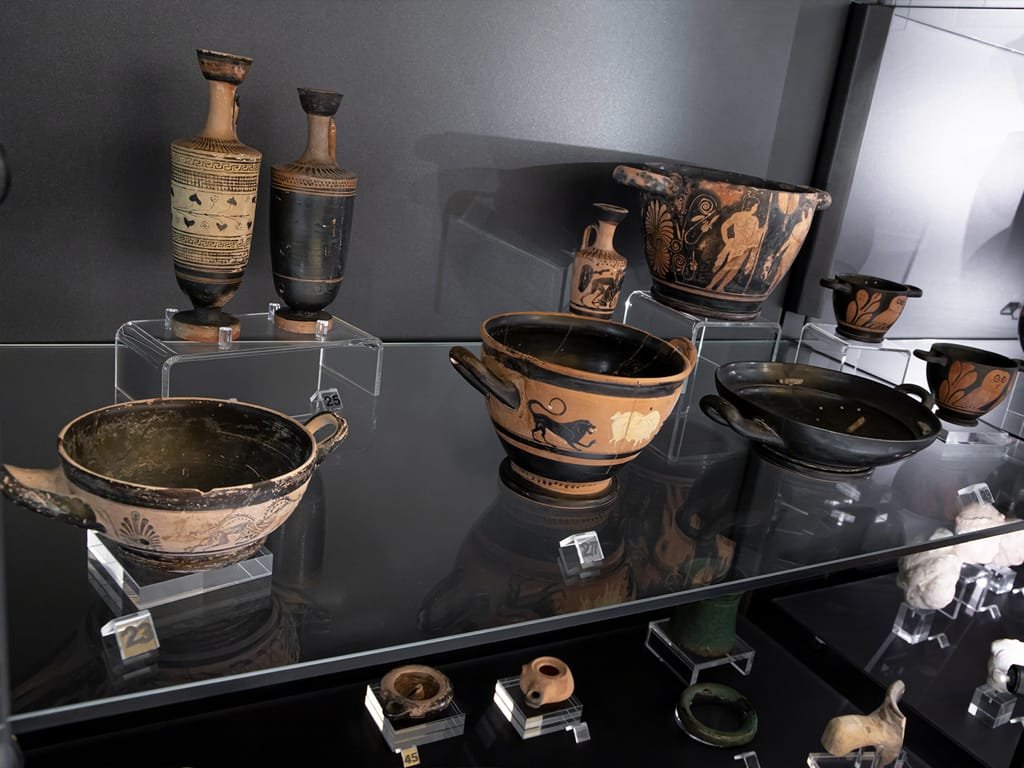
In the showcases 4 and 6 you will find the items from Greece and Magna Graecia (the Greek colonies in southern Italy) : these objects can be dated along a wide chronological span that from the eighth-seventh centuries B.C. goes up to the entire Hellenistic age. Among the collections in showcase n. 4 remember above all the vases from the donation of the spouses Michelangelo Merlìn and Oplinia Hieke. There are 23 artifacts ranging from the Middle Corinthian (late seventh century B.C.), to the Attic vases with black and red figures (sixth- fifth century B.C.). This collection nucleus is characterized by the quality of the individual finds and by an intentional selection of the artifacts. Among the Corinthian vases from the Merlìn-Hieke collection, dating from the seventh and sixth centuries B.C., observe a lèkythos, a kind of bottle, with zoomorphic decoration and two elegant skýphoi (drinking pots with deep tank) decorated respectively with floral trophy and sphinxes and with zoomorphic motifs. Among the Attic pottery there are, among the open forms, only drinking pots, kýlikes and skýphoi. Among the latter particularly significant are a red-figured attic skýphos representing two young male and two skýphoi with the figure of an owl, an animal associated with the goddess Athena and symbol of wisdom. Among the closed forms, you mainly see lèkythoi, a kind of cylindrical body bottles.
In the median shelf, on the right, see two Attic vases that don’t come from collections: the first is an hydrìa, a vase for water, donated to the museum by prof. Carlo Anti:; the second is a crater (a vase to mix the wine) that comes from a tomb in the area of the city of Spina, near the delta of the Po river, Italy. This burial unfortunately was violated by grave robbers: the vase was subsequently recovered by the Carabinieri (a branch of the Italian army) along with various objects from several tombs. The finds had been mixed together: for this reason they are displayed in several rooms of the Museum depending on the types and not according to the context, which can no longer be reconstructed. Finally, the lower shelves of the showcase contain several objects of daily life including oil lamps, a box mirror, terracotta votive statuettes and others in marble.
Leaving room 4, in the adjoining room 6 you will find vases, figured and architectural terracottas, bronze objects and coins from the areas of Greek colonization in southern Italy (the so-called Magna Graecia) with particular, though not exclusive, reference to the area of present-day Puglia. Almost all of the objects in this showcase belong to the Merlin spouses' collection. At the top left of the exhibitor, there is a valuable example of a Proto-Lucan bell-shaped crater attributable to the workshop of the Painter of Pisticci, dated to the end of the fifth century B.C.: it is decorated with scenes that allude to rites of passage of young male characters between youth and adulthood. Scenes that can be interpreted as moments of passage are also present on other red-figured vases, shown below, in particular two Apulian pelìkai (a sort of amphorae often containing oil) dating back between the end of the fifth century and the fourth century. B.C.: in the first vase you see a girl playing with the ball that is starting, following the god Eros, towards marriage. In the second pelike you will find a scene of exchanging gifts between young engaged couples.
The second most consistent group of vases belongs to the Gnathìa pottery or Gnathìa style pottery, a term which refers to a black paint production characterized by the application, before firing, of one or more colours, usually yellow, white and red, sometimes even with the use of graffiti. The vases exhibited here are mainly closed forms such as jugs, bottles, perfume holders but you can also admire, in the middle of the display case, two large skýphoi, decorated with vine shoots, bunches and vine leaves. A series of terracottas, datable between the fifth and third centuries B.C. also belong to the same exhibition and two bronze coins from Metaponto. Among the first you will find an antefix (an element that ends the head of the tiles) decorated with a Gòrgon head (any of three snake-haired sisters in Greek mythology) from Tarantine workshops and some other statuettes. In the same room, in a small case, 7 metal objects from the Merlin-Hieke collection are exhibited, ranging from the eighth century to the fourth century B.C.