Trascrizione
From the third century BC, the Romans proceeded in their conquest of northern Italy. In 49 BC, like other Po Valley cities such as Brescia and Milan, Mantua acquired Roman citizenship and was enrolled in the Sabatina tribe, one of the administrative districts of the state.
About a century later the poet Martial wrote: “Just as Verona owes much to its Catullus so does little Mantua to its Virgil.” So we know that the city did not become a large city but nevertheless reached a moderate level of prosperity, which could be seen from the discovery of lavish houses and imposing funerary monuments.
The urban area was organized as an orthogonal road system. The main streets, paved with large stones called basoli, were oriented in two different directions and crossed at right angles, creating quadrangular blocks. As had been the case in Etruscan times, the houses were concentrated mainly in the area of the so-called Civitas Vetus (old city), surrounded by the defensive walls.
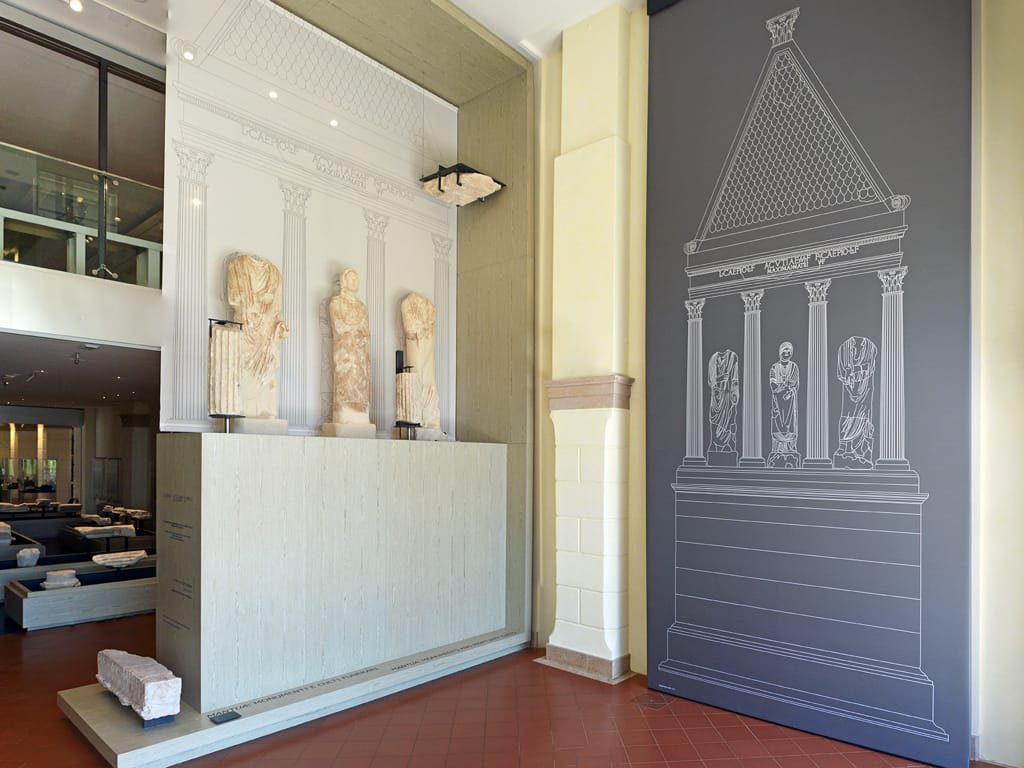
One of the most prominent families or gens of Roman Mantua was the Caepia. The word “gens” refers to a set of families who recognized that they had a common ancestor and origins. The Caepiae lived in the Augustan age, from the first century BC to the first century AD, and are remembered by two funerary inscriptions found at the Seminario Vescovile. Thanks to their sheer size, these monuments could be seen from afar by arriving travellers, thus celebrating the prosperity of the owners.
We can observe one – reconstructed to its original size – on the museum tour.
It was dedicated by two brothers, Lucius and Publius Caepio, to their mother Acutia Maxima, shown veiled and bejewelled between her sons.