Trascrizione
We are now in Isabella’s studiolo, where the marquise kept the core of her prestigious collection of paintings: Mantegna’s Minerva chases away the Vices and Parnassus; the Kingdom of the god Como and The Allegory of the Court of Isabella by Lorenzo Costa the Elder; Perugino’s Battle between Love and Chastity, and Correggio’s Allegory of Vice and Allegory of Virtues, the latter added in 1530, a few years after the marquise moved to Corte Vecchia.
In 1626 the seven works were sold to Cardinal Richelieu and are now in the Louvre.
A marble portal by Gian Cristoforo Romano marks the entrance to the second study, called the Grotta. On the walls, six wooden panels inlaid with urban views and still lifes with musical instruments were made by the Della Mola brothers in 1506 for the Castello Grotta. They were intended as doors for cabinets containing artistic and natural wonders.
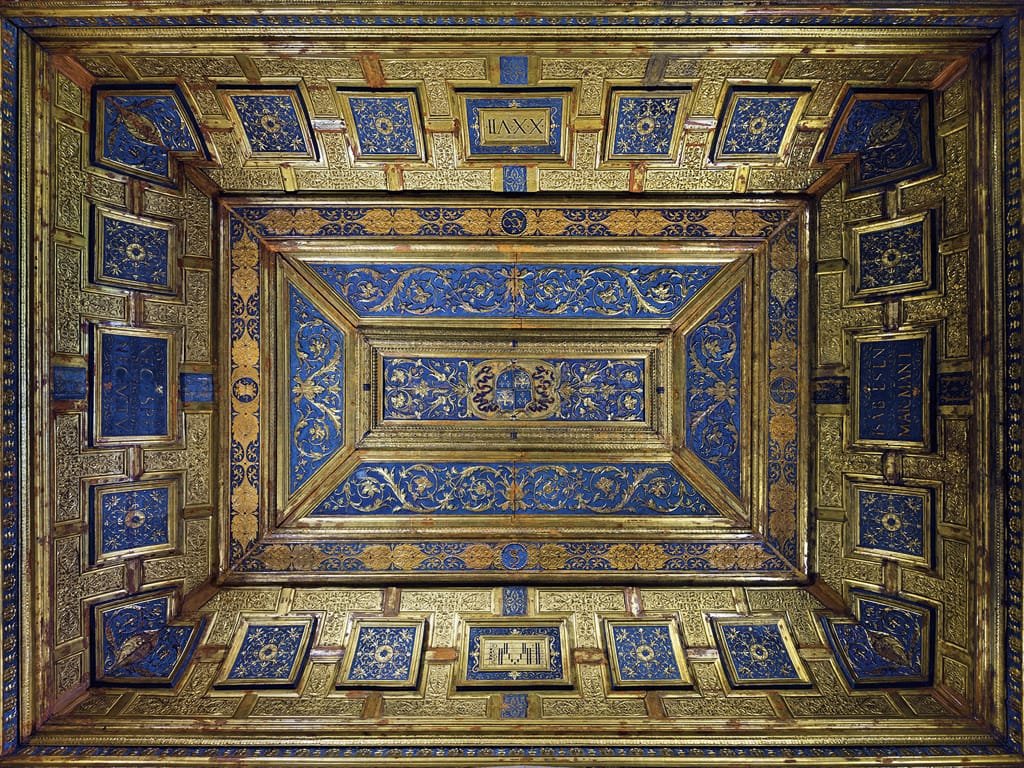
At the time of Isabella, this room housed antique cameos, carvings and carnelians, numerous modern bronzes by Jacopo Alari Bonacolsi, as well as two sleeping Cupids, one attributed to Praxiteles and the other sculpted by Michelangelo, in contrast with the antique corpus. On the ceiling, created specially for this room but with the addition of an older portion brought from the Castello Studiolo, there are emblems dear to the marquise: the Roman number Twenty-seven, which was pronounced “vinti-sette” to evoke the moral triumph of Isabella over the seven deadly sins; the motto “Nec Spe, Nec Metu” (“without hope, without fear”) celebrates her restrained demeanour and detachment from earthly things; the candlestick symbolized her uniqueness and brightness.
Annexed to the studies is a secret garden, enclosed by a wall with Ionic columns alternating with rectangular niches. A Latin inscription in the frieze states the name Isabella d’Este and the year 1522.