Trascrizione
Until the 1960s this room was called the Sala dei Principi because the frieze that decorated the upper part of the walls was composed of portraits of the Gonzaga princes, painted in 1701. An accurate examination of paint layers revealed previous artworks and after some careful consideration, it was decided to proceed with the removal of the surface strata.
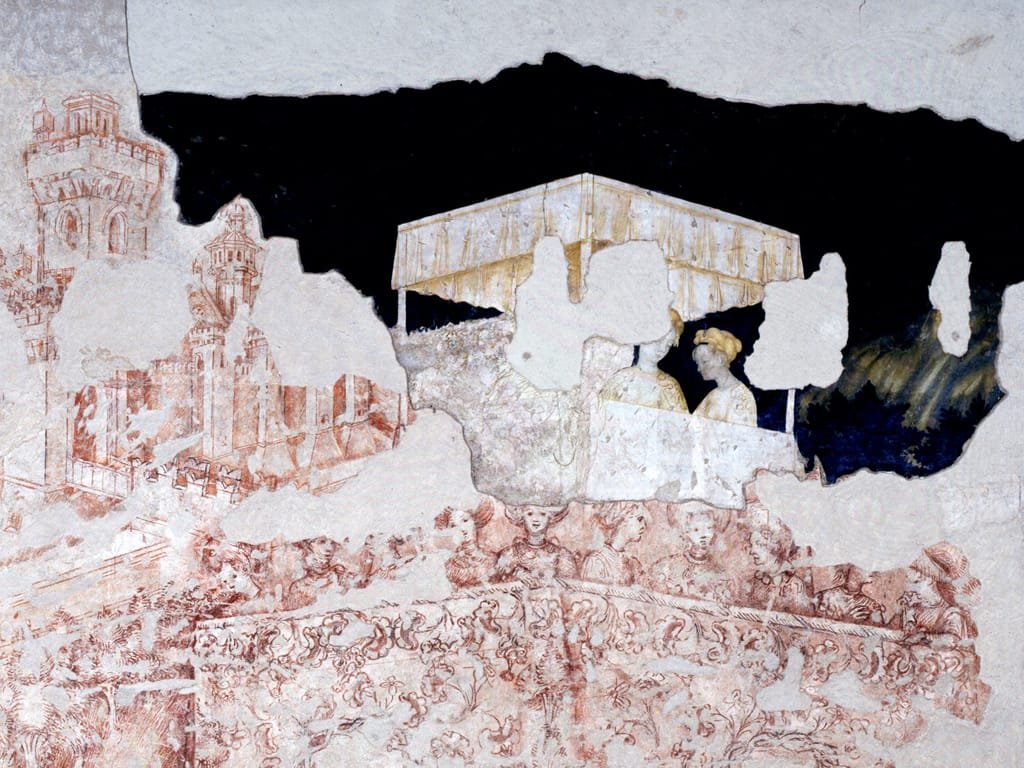
From the 1950s onwards, after the terrible losses of frescoes caused by Second World War bombings, art technicians and historians voted strongly in favour of removal. Moreover, in this case there was a desire to bring to light the preparatory drawing under a layer of paint known as sinopia (named after the Turkish town of Sinop) as it was the same dark reddish-brown colour of the earth pigment painters used to blend that particular hue.
Once the ceiling of the time was demolished and the eighteenth-century frieze removed, fragments of a faux-marble sixteenth-century decoration emerged, as did Pisanello’s Tournament cycle. The latter was also removed, using a bolster made from rolled up canvas.
In the case of the Tournament, not only was the fresco removed, but also the corresponding sinopia, which we can now see exhibited in the nearby Sala dei Papi. This room – named after a sixteenth-century frieze with portraits of popes of which only a small fragment remains – allows us to compare Pisanello’s preparatory drawing of red and black earth with the finished artwork restored in this room.