Trascrizione
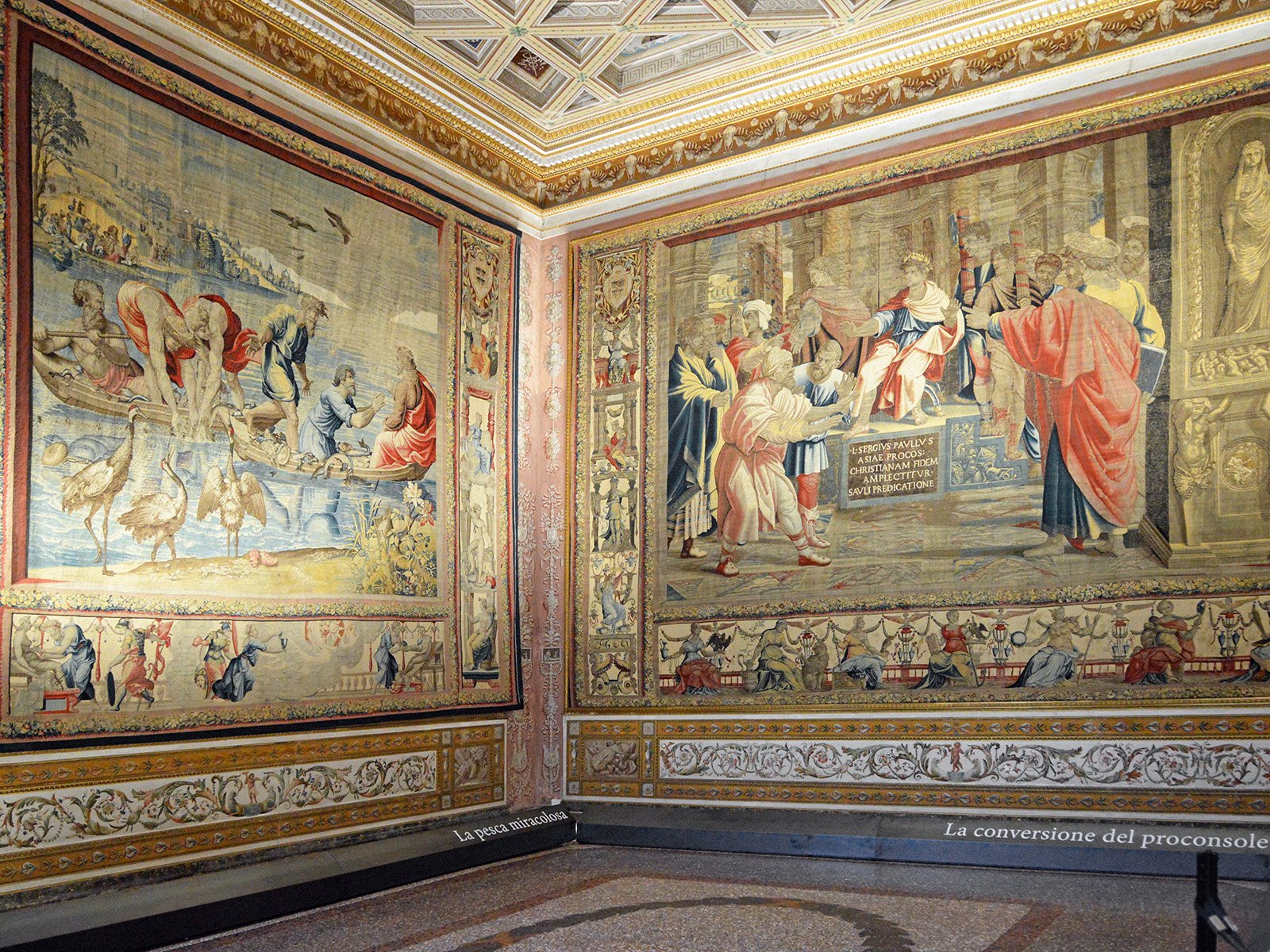
The Appartamento degli Arazzi overlooks the Giardino d’Onore garden and in about 1780 it was radically refurbished by architect Paolo Pozzo. The rooms were redesigned to accommodate a precious series of nine tapestries.
Pozzo made use of stucco reliefs taken from ancient Roman sarcophagi, and also of painted ceilings, period decorations on the walls and painted canvases, to achieve a coherent ensemble anticipating Neoclassical development.
The nine tapestries are installed in three rooms and were woven in Brussels to the cartoons the great Raphael Sanzio had made for a series commissioned by Pope Leo X, originally intended for the Sistine Chapel. Seven of the original cartoons are now found at the Victoria and Albert Museum in London.
More tapestries were woven from Raphael’s cartoons, which were left in Flanders even after his death. Of these replicas, the most important is probably the version in Mantua. The “set” of tapestries was purchased in about 1550 by Cardinal Ercole Gonzaga. The cardinal bequeathed the tapestries to be used as furnishings of the palace’s Basilica di Santa Barbara after his death. Purchased in 1776 for Palazzo Ducale, the pieces underwent major restoration in about 1780, entrusted to Antonia Carrè Lorenzini, and were then placed in the renovated Appartamento degli Arazzi.
In 1866, however, Austrian Emperor Franz Joseph had them taken to Schönbrunn Castle, in Austria. It was not until 1919, after the end of the First World War, that the tapestries were returned here.
The works illustrate Stories from the Lives of Saints Peter and Paul from the Acts of the Apostles. In the first room, known as the Sale dell’Aquila, you will find the first three tapestries of the series: with your back to the window, the Stoning of Stephen is on the right, the Blinding of Elymas is in the centre, and the Miraculous Catch of Fish is on the left. The main scene is framed by borders; over the vertical edging you can see the insignia of Cardinal Ercole, sewn onto a piece of cloth added later. This proves these tapestries were woven in series and that the affixing of the buyer’s coat of arms took place later. On the left tapestry, the only one unframed, you can see on the cimosa, that is, the blue band or selvedge at the bottom, the double B initials added by the Brussels weavers in 1528.