Trascrizione
You are now in the Sala dello Zodiaco, a name that has been in use since the beginning of the nineteenth century, the time when Mantua was governed by the French.
From the cornice downwards we see decorations dating back to 1812–14: the neo-Egyptian pilasters allude to Napoleon’s campaign in Egypt and the four overdoors, with bas reliefs depicting allegories of Napoleon are in stucco coloured to imitate bronze.
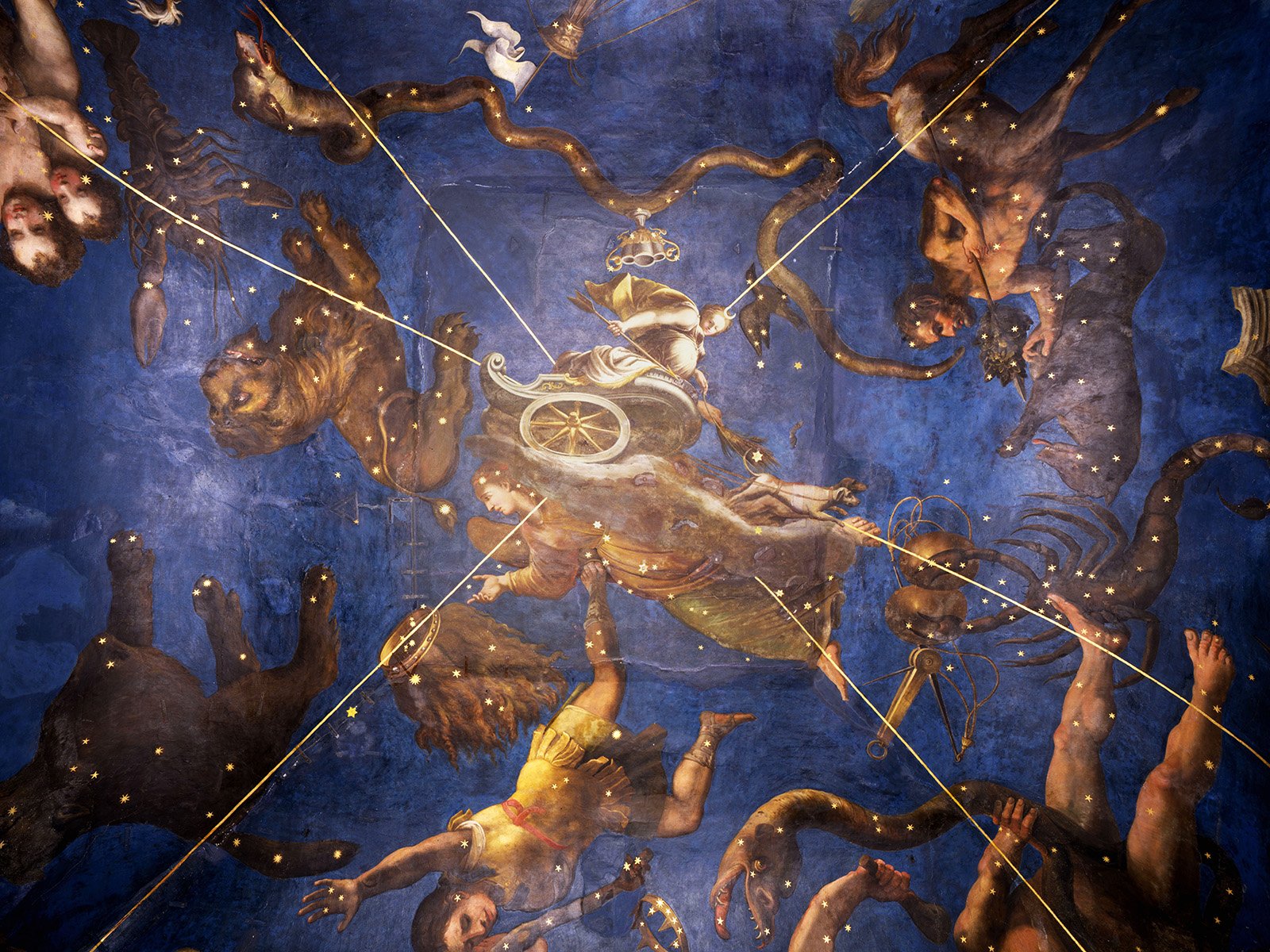
The vault decoration depicts Diana’s Chariot among the Constellations of the Zodiac on a night-blue sky. It was painted in about 1580 – so during Gonzaga rule – by Lorenzo Costa the Younger and his assistants. In the centre you will recognize the figures of pagan goddess Astraea, depicted holding ears of corn as she points to the constellation of Coma Berenices, and of Diana, the goddess of hunting, on her chariot drawn by dogs.
The reading of the complex representation of the zodiac must take into account the fact that the central panel portraying Diana, with its accentuated foreshortening, and part of the figure of Astraea, are attributable to a restoration dating to about 1755, carried out by painter Giovanni Cadioli.
It is worth noting that in ancient times the powerful figure of Astraea was assimilated to Virgo, the birth sign of Guglielmo Gonzaga, patron of the decoration, who resided in this apartment.
The representation of other constellations, including Gemini, Cancer and Libra unfolds around the central group, in accordance with a system certainly conceived by a learned court Humanist. Attention to horoscopes had a practical application in the Renaissance’s educated classes who relied on complex astrological calculations to pick a date for weddings, declarations of war, business matters, and for laying cornerstones for palaces or churches.
The paintings are not frescoes but oil on plaster layered over a vault constructed in “camorcanna”, intertwined marsh reeds suspended on a wooden frame.