Trascrizione
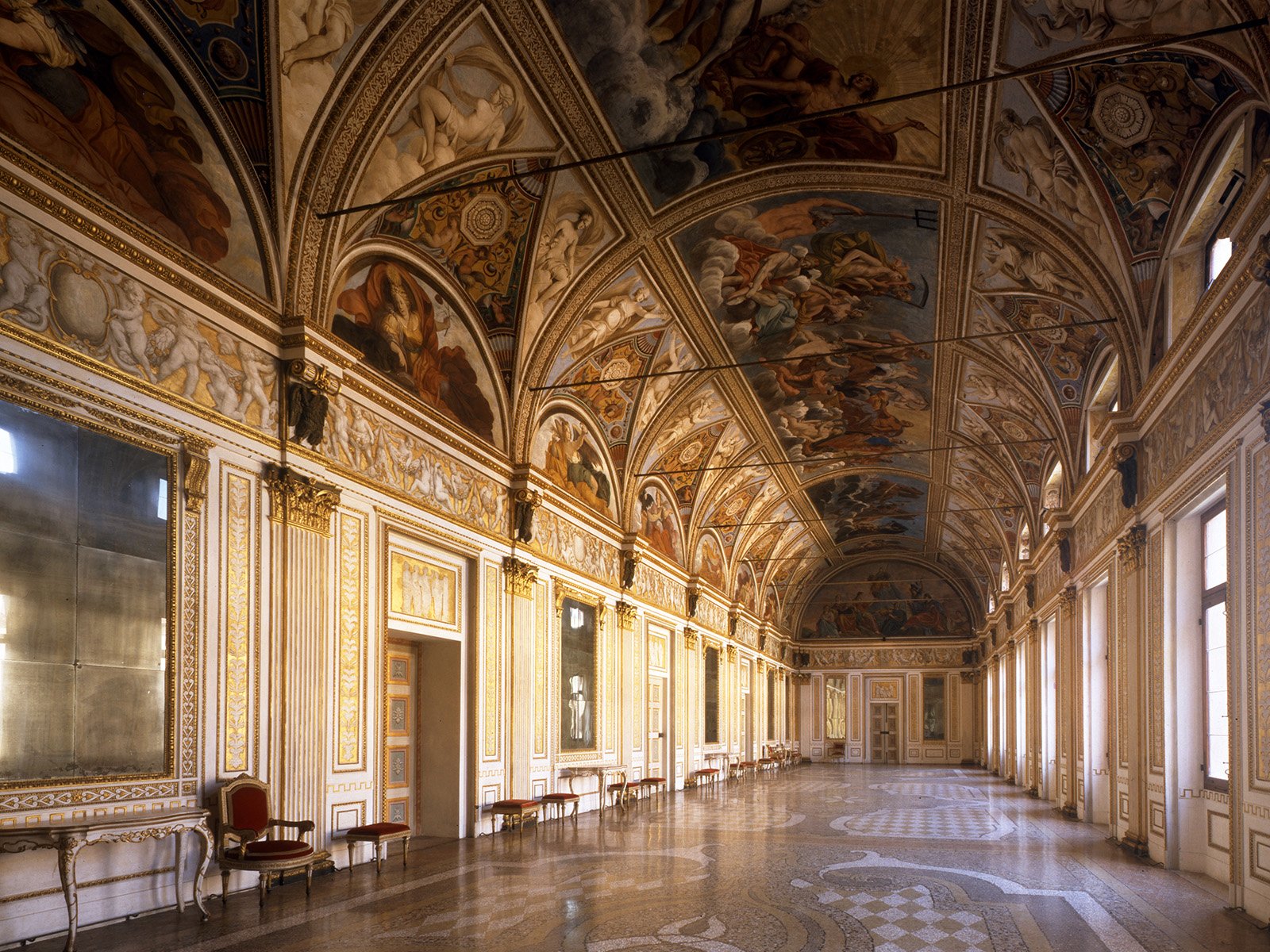
Originally this room was a loggia opening onto the courtyard below, part of the Appartamento Ducale, commissioned in about 1600 by Vincenzo I. Subsequently the loggia was turned into a “logion serato”, which is to say a gallery, and it was used to display paintings.
The pictorial decoration was added in about 1618, during the rule of Duke Ferdinando Gonzaga. The vault thus acquired three large panels with the Gods of Olympus depicted at the centre and the Chariot of Day and Chariot of Night to the sides.
The paintings are the work of various artists. The head lunette on the wall towards the Sala degli Arcieri is frescoed with Apollo and the Muses, by the hand of an assistant of Antonio Maria Viani, site prefect and coordinator of Gonzaga artistic works from the latter 1500s to 1630.
On the facing wall we see the Liberal Arts, signed in 1618 by Bavarian painter Karl Santner, nephew and pupil of Viani. The presence of a German painter points to the international awareness typical of the court of Mantua at the time.
The lunettes on the side opposite the windows may be by Jacopo Borbone, an Emilian painter. From right to left, they illustrate the following allegories: Eloquence, Benignity, Immortality, Intellect, Magnanimity, Affability, Liberality.
The impressive vault comprises various panels of which the three main works are probably by pupils of Guido Reni, who had been commissioned to work for Ferdinando Gonzaga. Specifically, Francesco Gessi may be the author of the Chariot of the Night, by the northern lunette, and Giangiacomo Sementi of the Council of the Gods, in the centre. The author of the Chariot of Day, by the southern head, is unknown.
In 1630, the city of Mantua was shaken to the core when complex dynastic and political events brought war, devastation and plague. The rooms of Palazzo Ducale were set alight with the rest of the city by the Lansquenets sent by the German Emperor. Three years earlier, Duke Carlo I Gonzaga-Nevers, in desperate financial straits, had sold many of the Palazzo Ducale treasures accumulated over the centuries, including the collections in the picture gallery.
In 1779, with the Gonzaga family but a distant memory, the Habsburg government that ruled Mantua at the time started a radical transformation of this and other rooms, aiming to meet its needs for state rooms. The walls were renovated in a Neoclassical key by Giocondo Albertolli, who designed the elegant pilasters, gilded stuccos and mirrors which give the room its name today.