Trascrizione
The great Sala degli Arcieri is home to one of the jewels of the Palazzo Ducale art gallery.
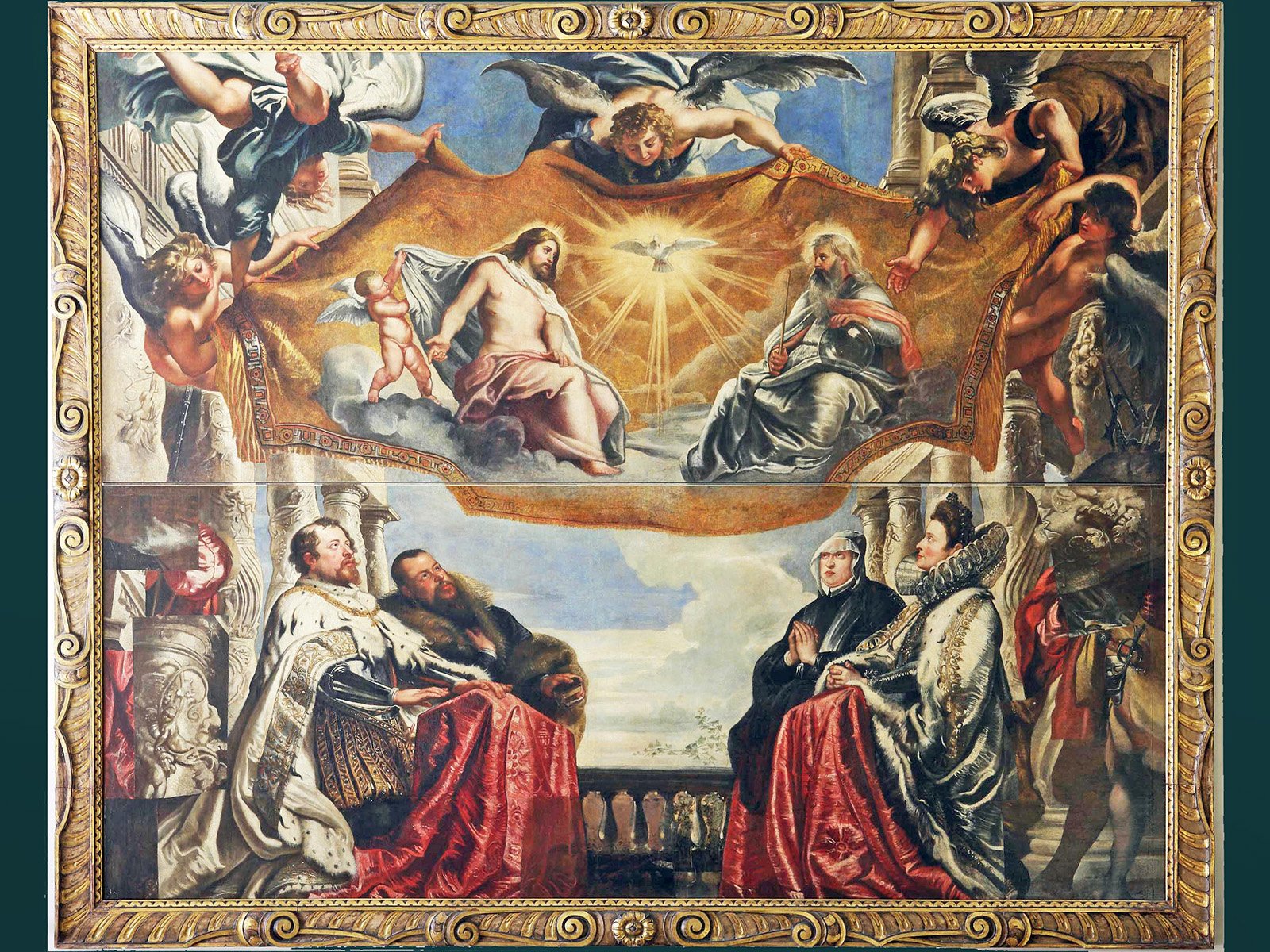
We are referring to the large canvas by Pieter Paul Rubens depicting the Gonzaga Family in Adoration of the Holy Trinity. This is a masterpiece standing on the horizon of Baroque in which Rubens successfully blended fluid brushstrokes of Venetian vein to the grandiloquent composition of Roman culture, and with numerous references and tributes to other great works.
It was completed in 1605 for the Jesuit Santissima Trinità church, together with side panels of the Baptism of Christ and the Transfiguration, now found respectively in museums in Antwerp and Nancy. The majestic triptych was commissioned by Vincenzo I Gonzaga to honour the memory of his mother Eleanor of Austria and his father Guglielmo Gonzaga.
French troops stole the Baptism of Christ in 1797, the Transfiguration in 1801, and attempted to steal the central section when a general cut the canvas into two horizontal strips to be able to remove it from the church. Some details of the composition, like the side portraits, were cut out to make separate artworks. The curious patchwork seen today is the result of attempts to stitch together the surviving parts. Unfortunately many are missing, especially from the left and right sides.
In the foreground of the painting you see Vincenzo I and his wife Eleonora de’ Medici in adoration of the Trinity, while Vincenzo’s late parents, Eleanor of Austria and Guglielmo, are placed in the background.
The Trinity is depicted as a tapestry held by flying angels and offered for veneration to the Gonzaga family. The portraits of the children – the boys on the left and the girls on the right – are scattered among private collections and European museums.
Since 2015, however, the portrait of Francis IV on the left has been on loan to the museum. The adjacent fragment with halberdier was donated by Alessandro Contini-Bonacossi in 1934, while the small dog on the right was entrusted to the gallery in 1936 by Verona’s Castelvecchio Museum.