Trascrizione
We are now in Corte Vecchia and precisely in the Appartamento Ducale, commissioned by Vincenzo I in about 1600.
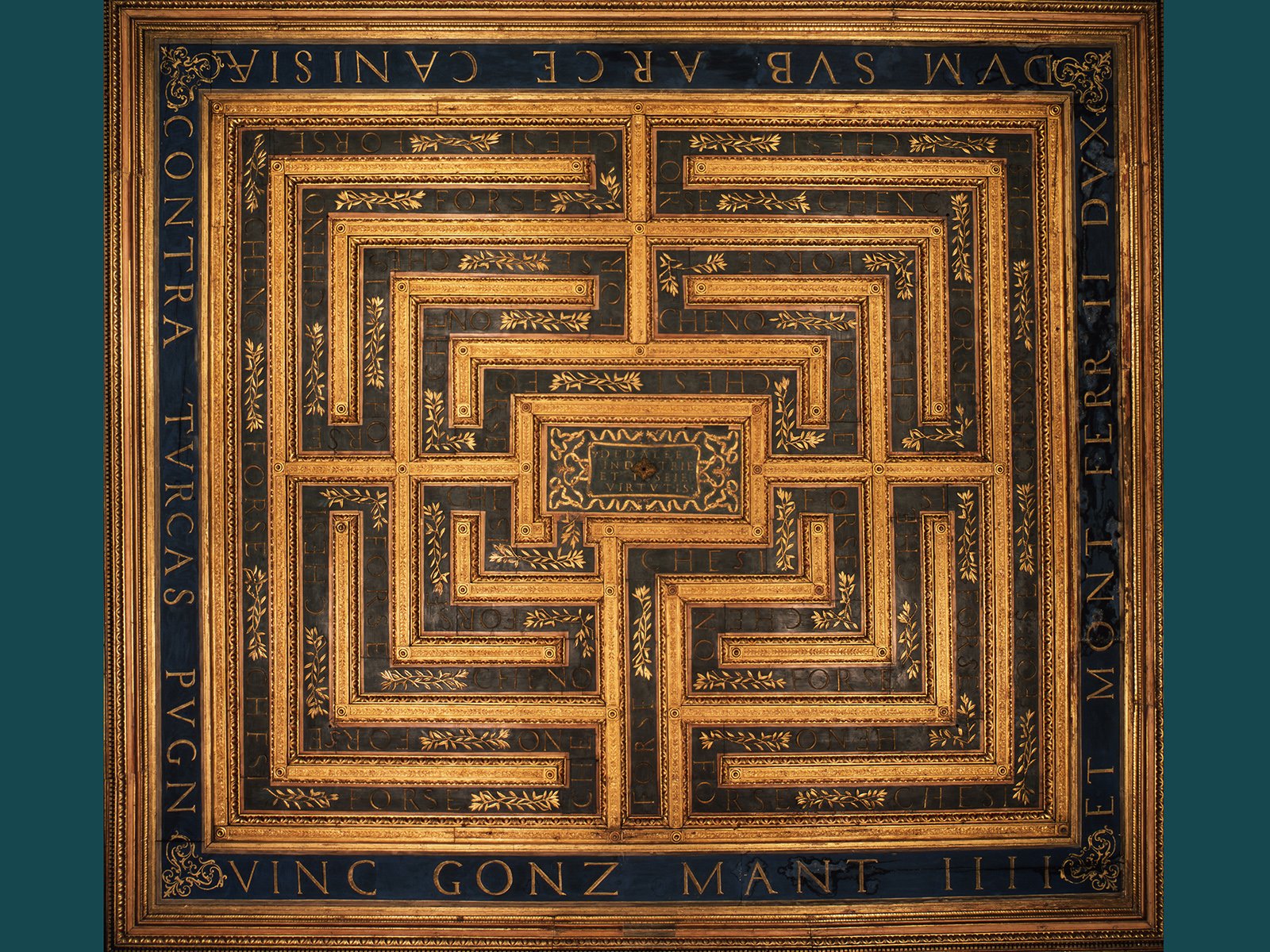
The name of the room comes from the rich decoration of its ceiling. The motto “perhaps yes, perhaps no”, which wends around the labyrinth’s meanders, derives from the text of a frottola, a popular song with a romantic theme, composed by Marchetto Cara and published in Venice in 1504. The central part of the ceiling was actually built at the turn of that century for the Palazzo di San Sebastiano, then moved to this site and adapted in about 1600, with the addition of an inscription that runs along the perimeter.
The wording commemorates Duke Vincenzo Gonzaga’s participation alongside imperial troops, in the 1601 siege of the Hungarian fortress of Canìssa, which had been taken by the Turks.
Labyrinths were dear to the Gonzagas, who had garden mazes laid out on several occasions and who also adopted the labyrinth pattern in other decorations.
The four large canvases placed high up on the walls come from the Pico family’s Mirandola palace and were brought to Mantua in 1716 by the Habsburg administration.
The majestic works depict the Four Ages of the World and were painted in about 1610. The Golden Age, which we see on the wall opposite the windows, is by Sante Peranda. The cycle develops clockwise with two other works by Peranda – The Silver Age and The Bronze Age – and ends with The Iron Age by Jacopo Palma the Younger.
There are also some eye-catching marble sculptures, in particular two portraits by Roman artist Lorenzo Ottoni, who trained at the school of the famous Ercole Ferrata, and was active at the end of the 1600s. The marbles show a skill typical of Gianlorenzo Bernini, a legacy clearly visible in the lovely lace decorating the garments.