Trascrizione
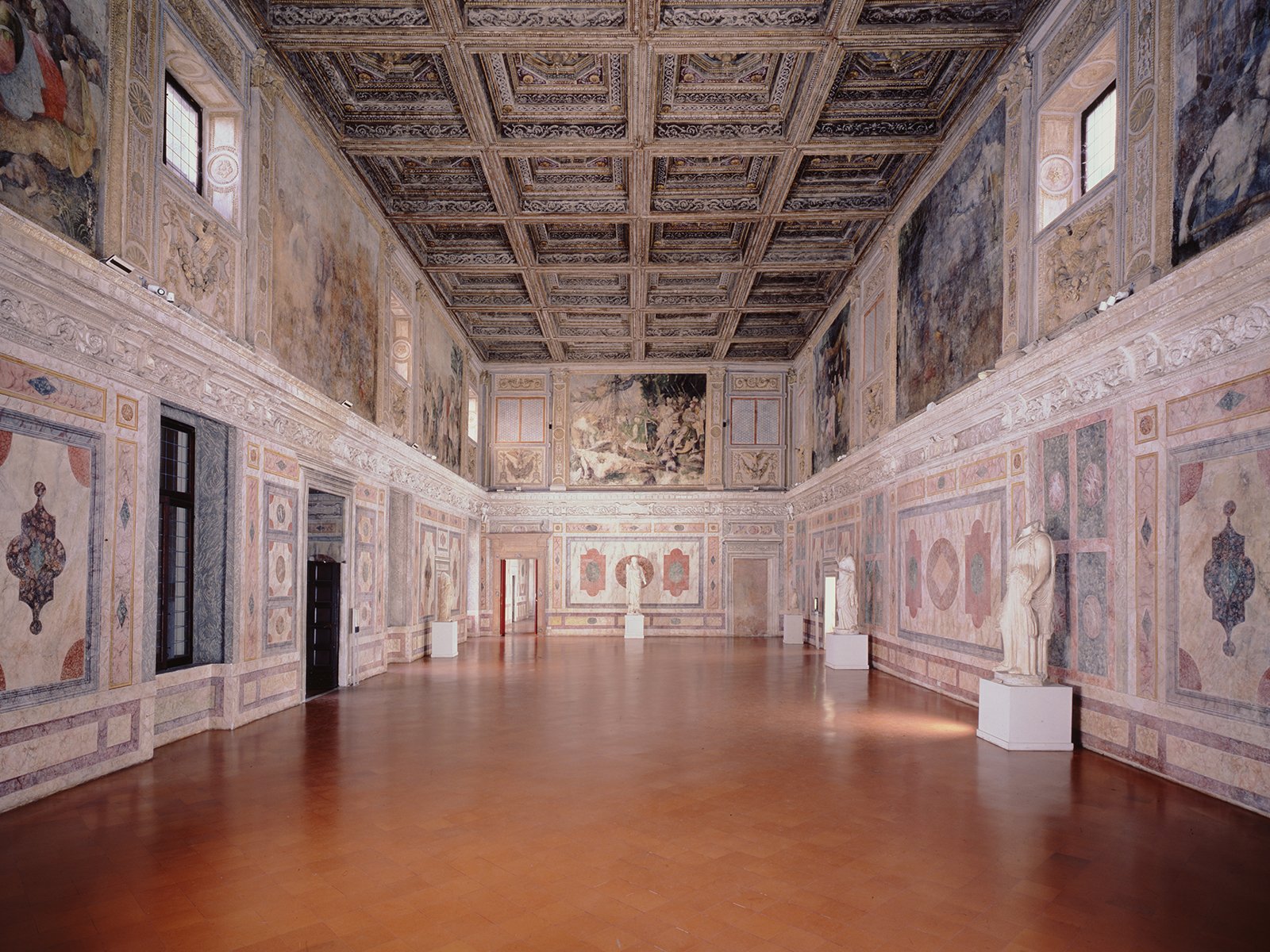
This is the largest room you will visit during the tour of the palace. It is rectangular with a coffered ceiling with richly decorated wood inlay.
It takes its name “Sala di Manto”, in honour of the mythical founder of the city of Mantua. Known in Greek culture as the daughter of the soothsayer Tiresias, Manto is mentioned by Virgil in his Aeneid, and by Ovid in his Metamorphoses. In this room she is depicted as the main figure in two of the eight stories painted in the upper order. The origins of the room can be dated to 1549, painted on the occasion of Francesco III Gonzaga’s marriage, when the large staircase connecting the castle to the Sala di Manto was also added.
The room acts as a passageway since it leads into the Appartamento Grande di Castello and the Appartamento di Troia, the so-called “Corte Nuova”. Then to one side we have the Santa Barbara corridor connecting to the Corte Vecchia.
In the early nineteenth century, it was thought that the Sala di Manto was older even than the Appartamento di Troia, and that it had been decorated by Mantegna. At the time it was called “Sala di Enea” because the inlaid panels in the upper part of the walls were believed to depict the life of Aeneas. The confusion also gave the name of “Scalone di Enea” to the access stairs, which are still used today.
Returning to the illustrations of the life of Manto, how should you interpret them? The two episodes depicted of the mythological origins of the city are the Landing of Manto and the Banquet of Manto. The first scene is on the short wall on the right facing the staircase; the other follows if you turn your gaze clockwise.
The history of the city, beginning with its legendary origins, narrated by Virgil and other classical texts, is thus linked with the history of the Gonzaga family. The Sala di Manto was intended to establish ideal continuity and consequently the legitimacy of the ruling family’s power.