Trascrizione
We are about to enter the Camera degli Sposi, also known as the Camera Picta; the “most beautiful room in the world” as it was described as soon as it was completed, in 1474. This is the most important surviving work by Andrea Mantegna and a masterpiece that deserves all your attention, without too many distractions. Please then, listen first, then turn off personal devices and just enjoy the art. The Camera degli Sposi is quite small so please do not linger for more than five minutes to see it all.
But first you should take a look around. We are in the Castello di San Giorgio, probably built in about 1397 by order of the captain of the people, Francesco I Gonzaga. We will talk more about this stronghold later, so that you do not get delayed in reaching the Camera degli Sposi.
Precisely because the room is so small, Mantegna devised an integral decorative cycle set on a painted architectural plan. His use of perspective is stunning and the colours are vibrant and full of light.
You can see a faux marble base with red and green discs, supporting pillars with painted friezes; the capitals support poles on which the artist painted heavy damask curtains. On two separate walls you can enjoy the two important episodes linked to the history of the Gonzaga family.
To understand the first painting, seen on the fireplace wall, you need to know that in January 1462, Ludovico II received a letter from Bianca Maria Sforza, summoning him to Milan to help her husband, Duke Francesco, who was seriously ill. You see the Marquis holding the letter and with a worried look he addresses his secretary, who approaches from the left. To his right sits his wife Barbara of Brandenburg, in a gown with rich damask puffed sleeves; alongside, some of their many children, councillors and courtiers crowd the scene. We know that the dog crouched under Ludovico’s seat was called Rubino.
In the second episode, on the left you see the meeting between Ludovico II, in profile, and his son Francesco in cardinal’s robes.
The characters depicted make up an authentic portrait gallery of the Gonzagas and in the background there are leading figures of the European scenario of the time, proof that the lords of Mantua were part of political and ecclesiastical power systems.
In the false pilaster to the right of the door, Mantegna concealed his self-portrait, a monochrome mask, high up among the plant friezes.
On the vault above, you can see a breathtaking repertoire of classical images, rendered as reliefs on a golden mosaic background. There are mythological scenes dedicated to Orpheus, Arion and Hercules, as well as eight busts of Roman emperors.
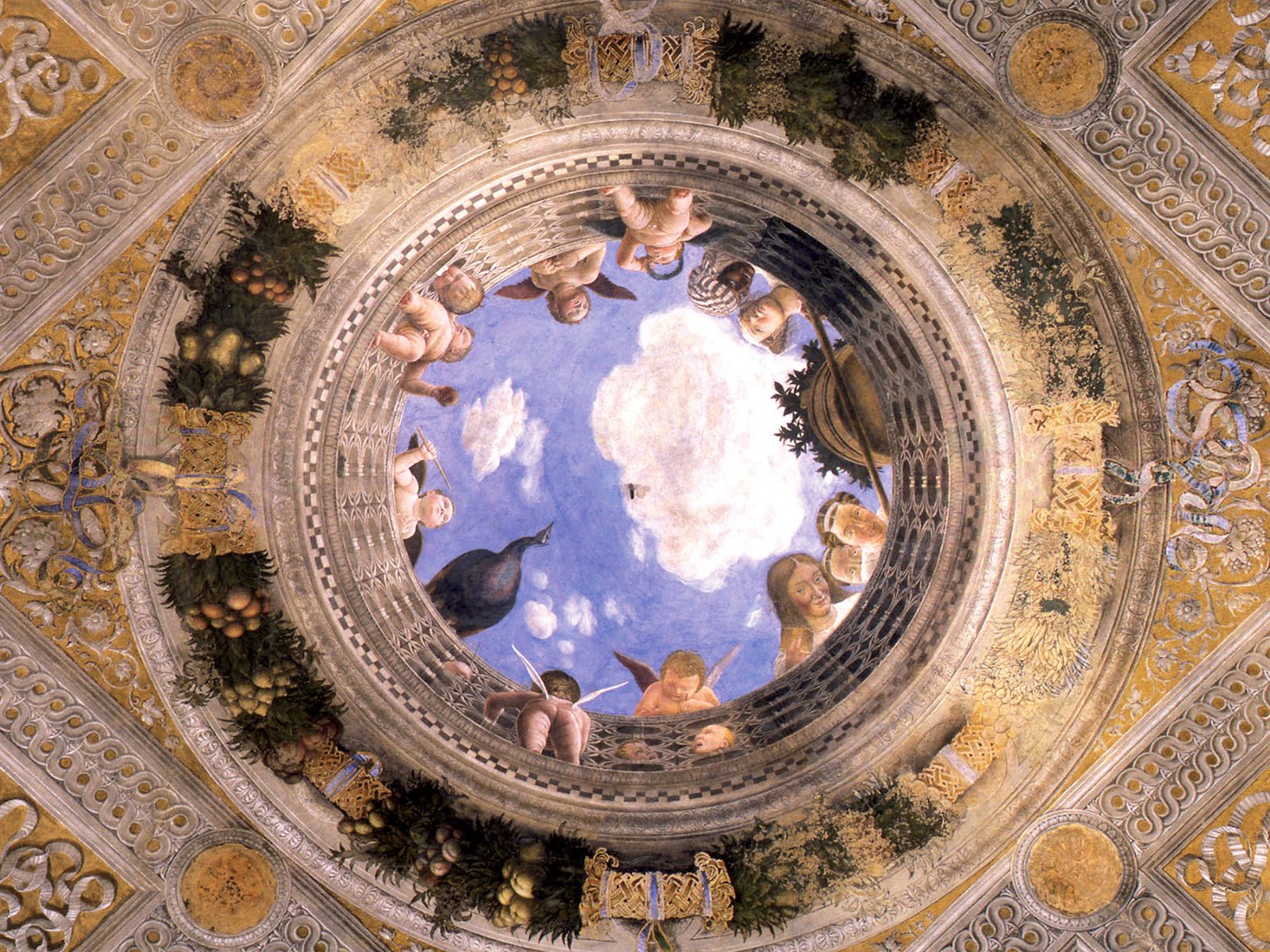
The ingenious central oculus seems to open the ceiling towards a blue sky, beyond a balustrade from which winged cherubs, a number of women, and a peacock look out.
Was there a source of inspiration for this masterwork? So it would seem. Various clues suggest that Mantegna was inspired by Lucian of Samòsata’s De domo, in which the ancient philosopher describes a beautiful painted room, the ideal place for a prince, which gives the impression of welcoming the sun and being filled with light.