The last part of the gallery brings together important works commissioned by Georg von Liechtenstein, prince bishop between the 14th and 15th centuries. A cultured descendant of an ancient Austro-Moravian family, he was responsible for the local propagation of the court culture known as International Gothic, of which the frescoes he commissioned for the Torre dell’Aquila in Castello del Buonconsiglio are the most famous example in Trento.
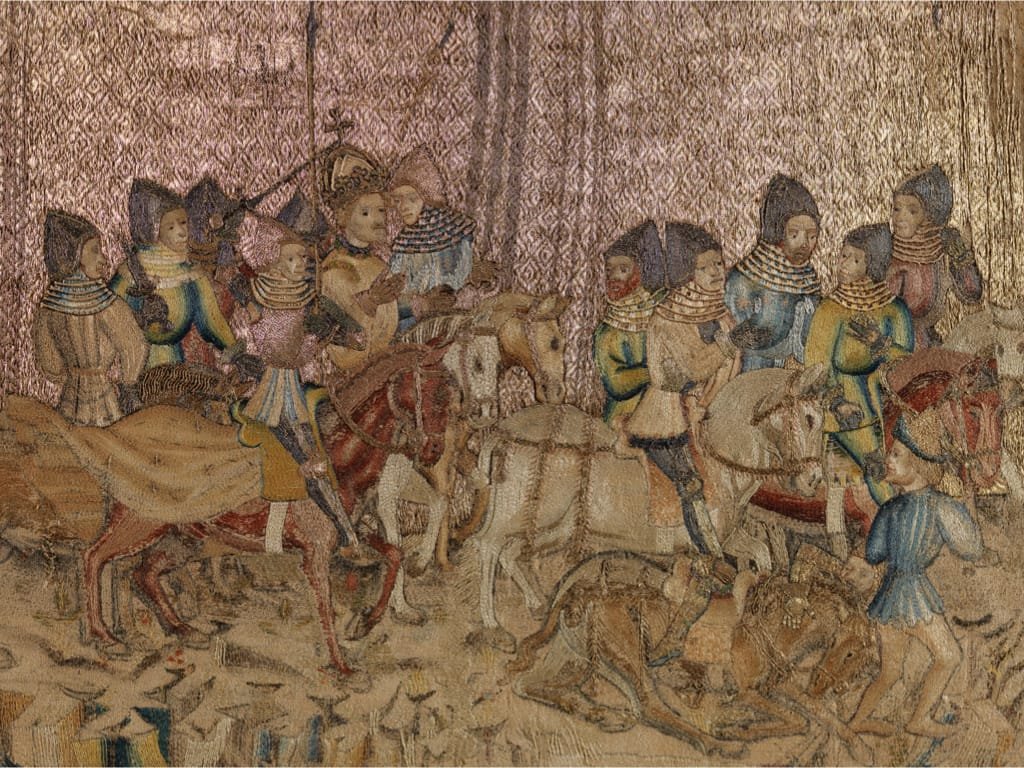
Perhaps the same artist of the Cycle of the Months authored the cartoons on which the stories of Saint Vigilius, commissioned by Liechtenstein for his episcopal consecration in 1390, were reproduced by the skilled hands of itinerant embroiderers originally from Prague. The images reflect the episodes narrated in the Passio Sancti Vigilii, an eighth-century text that narrates, through a combination of legend and reality, the origin of the prince-bishopric. According to the ancient text, the pope sent the book with the story of Saint Vigilius to the Emperor, who had it sewn inside a flag as a good omen for an imminent battle against the barbarians. After the victory, the emperor decided to grant the Tridentine fief as a reward to the bishop of Trento.
Also belonging to Liechtenstein's collection are the large staff cross, or processional cross in gilded silver, and the architectural ostensory reliquary of Saint Blaise. Both bear two small shields with the coat of arms of Trento (the eagle) and the emblem of the Liechtenstein family.
Trascrizione
The last part of the gallery brings together important works commissioned by Georg von Liechtenstein, prince bishop between the 14th and 15th centuries. A cultured descendant of an ancient Austro-Moravian family, he was responsible for the local propagation of the court culture known as International Gothic, of which the frescoes he commissioned for the Torre dell’Aquila in Castello del Buonconsiglio are the most famous example in Trento.
Perhaps the same artist of the Cycle of the Months authored the cartoons on which the stories of Saint Vigilius, commissioned by Liechtenstein for his episcopal consecration in 1390, were reproduced by the skilled hands of itinerant embroiderers originally from Prague. The images reflect the episodes narrated in the Passio Sancti Vigilii, an eighth-century text that narrates, through a combination of legend and reality, the origin of the prince-bishopric. According to the ancient text, the pope sent the book with the story of Saint Vigilius to the Emperor, who had it sewn inside a flag as a good omen for an imminent battle against the barbarians. After the victory, the emperor decided to grant the Tridentine fief as a reward to the bishop of Trento.
Also belonging to Liechtenstein's collection are the large staff cross, or processional cross in gilded silver, and the architectural ostensory reliquary of Saint Blaise. Both bear two small shields with the coat of arms of Trento (the eagle) and the emblem of the Liechtenstein family.