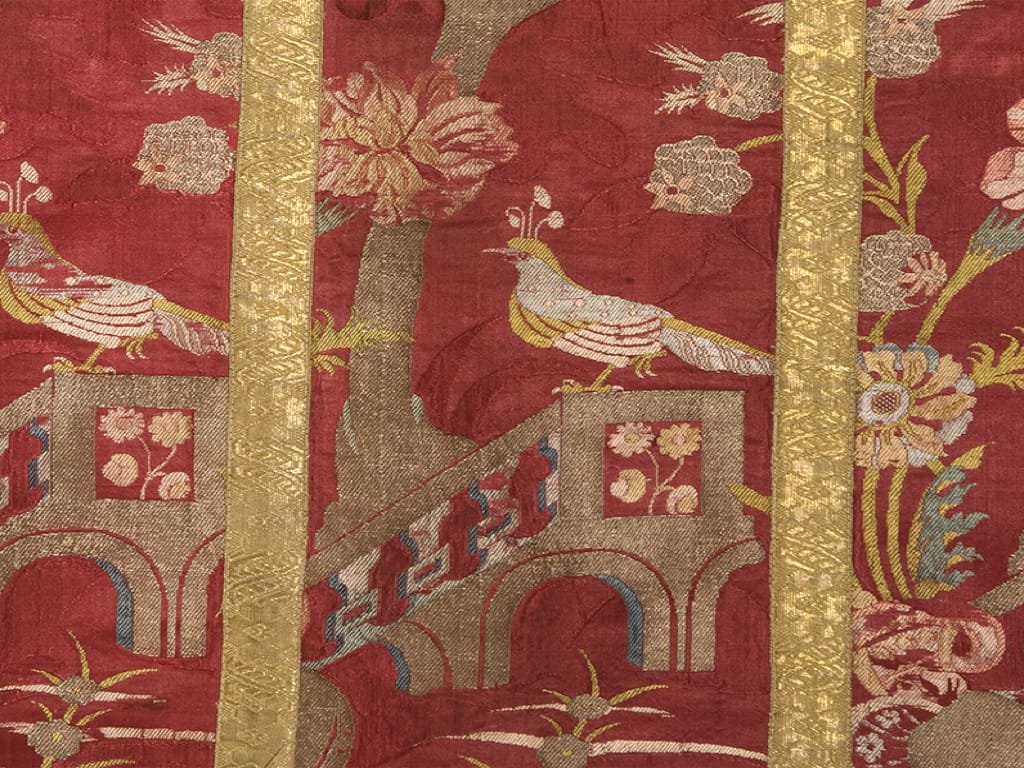
The liturgical vestments, that is, the garments worn by the clergy, displayed in this gallery are part of the collection assembled at the beginning of the 20th century by the first director of the museum, Monsignor Vincenzo Casagrande. The collection, remarkable for the number, variety, and quality of vestments, comprises a wide range of fabrics - including velvets, damasks, lampas, and satins - as well as multiple decorative patterns that exemplify the most significant moments in the development of European textile manufacturing from the 15th to the 19th century.
It is interesting to note that the designs and decorations of most of these fabrics were not applied retrospectively, as would be done with embroidery, but were created "in opera", as part of the weaving process on a loom through the effect of weaving pattern and colour, or even just varying the twist of threads made of silk or precious metals such as gold and silver.
These fine fabrics were not made exclusively for the clergy but were also used to make luxurious garments for the aristocracy. If the tapestries of the Clesio, displayed on the second floor of the museum, are a visual sample of late Medieval fashion, the vestments exhibited here represent their textile counterpart, which you can touch thanks to the samples arranged along the left wall. Ordered chronologically, these illustrate the evolution of textile art between the 15th and 18th centuries, as only from the 19th century did some manufacturing begin to specialise in producing silk fabrics exclusively for the Church.
Trascrizione
The liturgical vestments, that is, the garments worn by the clergy, displayed in this gallery are part of the collection assembled at the beginning of the 20th century by the first director of the museum, Monsignor Vincenzo Casagrande. The collection, remarkable for the number, variety, and quality of vestments, comprises a wide range of fabrics - including velvets, damasks, lampas, and satins - as well as multiple decorative patterns that exemplify the most significant moments in the development of European textile manufacturing from the 15th to the 19th century.
It is interesting to note that the designs and decorations of most of these fabrics were not applied retrospectively, as would be done with embroidery, but were created as part of the weaving process on a loom through the effect of weaving pattern and colour, or even just varying the twist of threads made of silk or precious metals such as gold and silver.
These fine fabrics were not made exclusively for the clergy but were also used to make luxurious garments for the aristocracy. If the tapestries of the Clesio, displayed on the second floor of the museum, are a visual sample of late Mediaeval fashion, the vestments exhibited here represent their textile counterpart, which you can touch thanks to the samples arranged along the left wall. Ordered chronologically, these illustrate the evolution of textile art between the 15th and 18th centuries, as only from the 19th century did some manufacturing begin to specialise in producing silk fabrics exclusively for the Church.