Between the Middle Ages and the early modern period in Europe, Jews were often subjected to "blood libel" accusations, rumors rooted in superstition and prejudice that portrayed them as responsible for the kidnapping, torture, and ritual killing of Christian children during Holy Week, in order to use their blood in magical-religious practices.
These slanders compounded numerous anti-Semitic stereotypes, such as the accusation of deicide, and were fueled by a general "fear of the other" as well as by the Franciscan preaching of the time, which strongly condemned those who lent money at interest.
Inserted into this context, is the story of Simon, an ill-fated child we discussed at the beginning of this tour - I invite you to listen to the section dedicated to Bishop Hinderbach, if you haven't already, for details of the story.
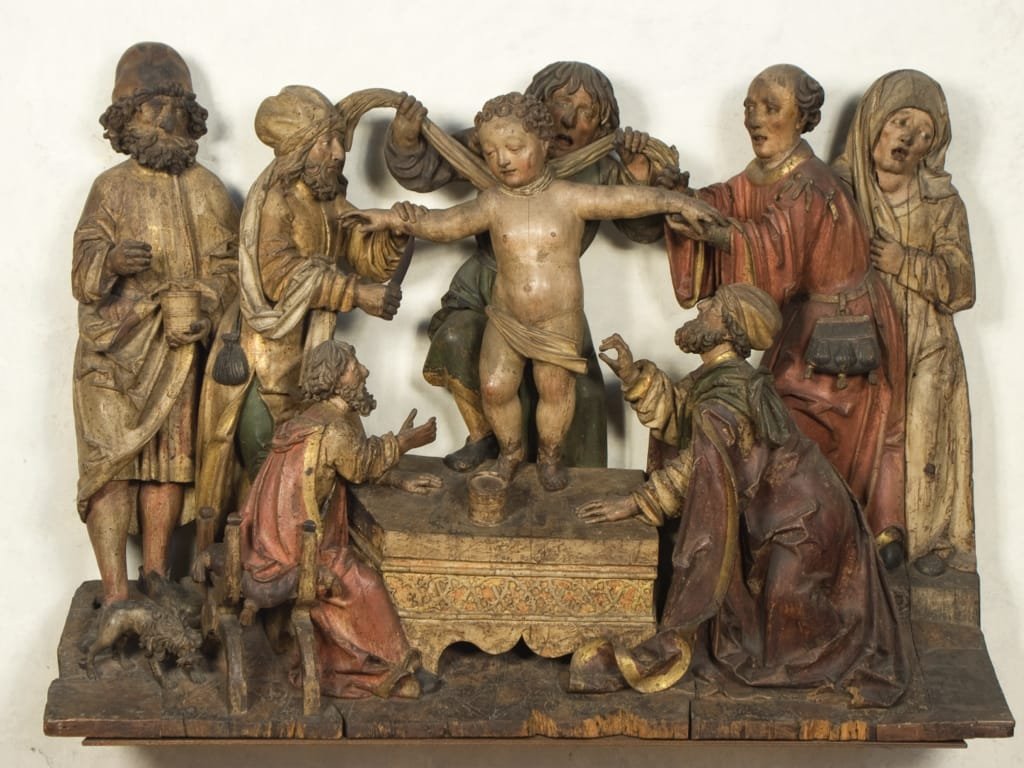
The body of the child was exhibited on the same day of its discovery on the altar of the church of Saint Peter in Trento, and immediately became an object of popular devotion. The wooden relief exhibited in this room, made at the beginning of the 16th century and taken from the very altar of that church, represents the alleged martyrdom as described in the forced confessions of the accused, all extracted under torture.
Although the dynamics of the trial had already raised doubts among some citizens and later in the papal legate when tasked with deciding whether Simon should be beatified or not, the cult of the ill-fated child spread rapidly. Pope Sixtus IV refused to canonise him in 1475, but in 1584, thanks to the intervention of Prince Bishop Ludovico Madruzzo, Simon's name was inserted into the roman martyrology, ratifying the "de facto" situation.
Trascrizione
Between the Middle Ages and the early modern period in Europe, Jews were often subjected to "blood libel" accusations, rumors rooted in superstition and prejudice that portrayed them as responsible for the kidnapping, torture, and ritual killing of Christian children during Holy Week, in order to use their blood in magical-religious practices.
These slanders compounded numerous anti-Semitic stereotypes, such as the accusation of deicide, and were fueled by a general "fear of the other" as well as by the Franciscan preaching of the time, which strongly condemned those who lent money at interest.
Inserted into this context, is the story of Simon, an ill-fated child we discussed at the beginning of this tour - I invite you to listen to the section dedicated to Bishop Hinderbach, if you haven't already, for details of the story.
The body of the child was exhibited on the same day of its discovery on the altar of the church of Saint Peter in Trento, and immediately became an object of popular devotion. The wooden relief exhibited in this room, made at the beginning of the 16th century and taken from the very altar of that church, represents the alleged martyrdom as described in the forced confessions of the accused, all extracted under torture.
Although the dynamics of the trial had already raised doubts among some citizens and later in the papal legate when tasked with deciding whether Simon should be beatified or not, the cult of the ill-fated child spread rapidly. Pope Sixtus IV refused to canonise him in 1475, but in 1584, thanks to the intervention of Prince Bishop Ludovico Madruzzo, Simon's name was inserted into the roman martyrology, ratifying the "de facto" situation.