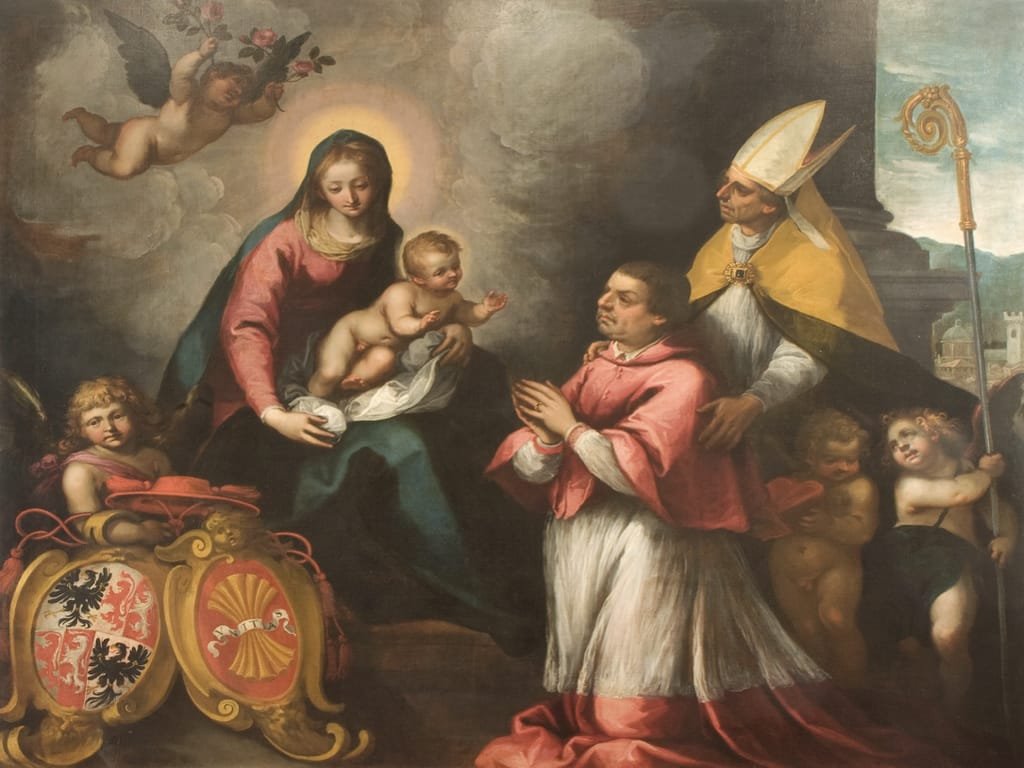
Martino Teofilo Polacco emerged as the most perceptive interpreter of the Counter-Reformation activity of Carlo Gaudenzio Madruzzo, Prince Bishop of Trento in the early seventeenth century. An artist of unknown origins, Polacco spent a period of training in Central-Eastern Europe, from which his pseudonym derives, before moving to Venice, where he came into contact with the Venetian colorism of the time.
Arriving in Trento around 1600, the artist was hosted by Madruzzo in the Castello del Buonconsiglio, from where he worked for the episcopal court and for the churches of the diocese until at least 1621, when he moved first to regions beyond the Alps and finally to Bressanone.
The numerous altarpieces from his Trento period, as well as the decoration of the Sanctuary of the Inviolata in Riva del Garda, are characterised by an emphatic and grandiose style, in which Polacco reworked both the Venetian teachings of Jacopo Palma il Giovane and a typically Northern European expressive style. The use of intense and vivid colours, the creation of luminous and evocative atmospheres, and the dramatic force of the characters are indeed counterbalanced in his work by clear references to Flemish prints, often dominated by intricate compositions rich in narrative details.
An example of this is the two "predella" exhibited here, rectangular panels that formed the lower base of two altarpieces originally located in the cathedral. The first, part of the altar of San Cristoforo, depicts the life of the martyr Saint Dorothy and the conversion of Theophilus. The second, part of the Assumption altar, depicts episodes from the Gospel of Matthew: the massacre of the innocents on the left and the flight of the Holy Family into Egypt on the right.
Trascrizione
Martino Teofilo Polacco emerged as the most perceptive interpreter of the Counter-Reformation activity of Carlo Gaudenzio Madruzzo, Prince Bishop of Trento in the early seventeenth century. An artist of unknown origins, Polacco spent a period of training in Central-Eastern Europe, from which his pseudonym derives, before moving to Venice, where he came into contact with the Venetian colorism of the time.
Arriving in Trento around 1600, the artist was hosted by Madruzzo in the Castello del Buonconsiglio, from where he worked for the episcopal court and for the churches of the diocese until at least 1621, when he moved first to regions beyond the Alps and finally to Bressanone.
The numerous altarpieces from his Trento period, as well as the decoration of the Sanctuary of the Inviolata in Riva del Garda, are characterised by an emphatic and grandiose style, in which Polacco reworked both the Venetian teachings of Jacopo Palma il Giovane and a typically Northern European expressive style. The use of intense and vivid colours, the creation of luminous and evocative atmospheres, and the dramatic force of the characters are indeed counterbalanced in his work by clear references to Flemish prints, often dominated by intricate compositions rich in narrative details.
An example of this is the two "predella" exhibited here, rectangular panels that formed the lower base of two altarpieces originally located in the cathedral. The first, part of the altar of San Cristoforo, depicts the life of the martyr Saint Dorothy and the conversion of Theophilus. The second, part of the Assumption altar, depicts episodes from the Gospel of Matthew: the massacre of the innocents on the left and the flight of the Holy Family into Egypt on the right.