The panel paintings you find in this room come from the San Vigilio Cathedral, where they were originally hung above the tombs of their illustrious patrons. This type of imagery, known as figurative epitaphs, was widespread in the German context and served to commemorate the deceased, who were portrayed kneeling in prayer alongside their patron saints. An inscription usually accompanied the painting, recording the name of the departed person, and forming an organic whole with the grave.
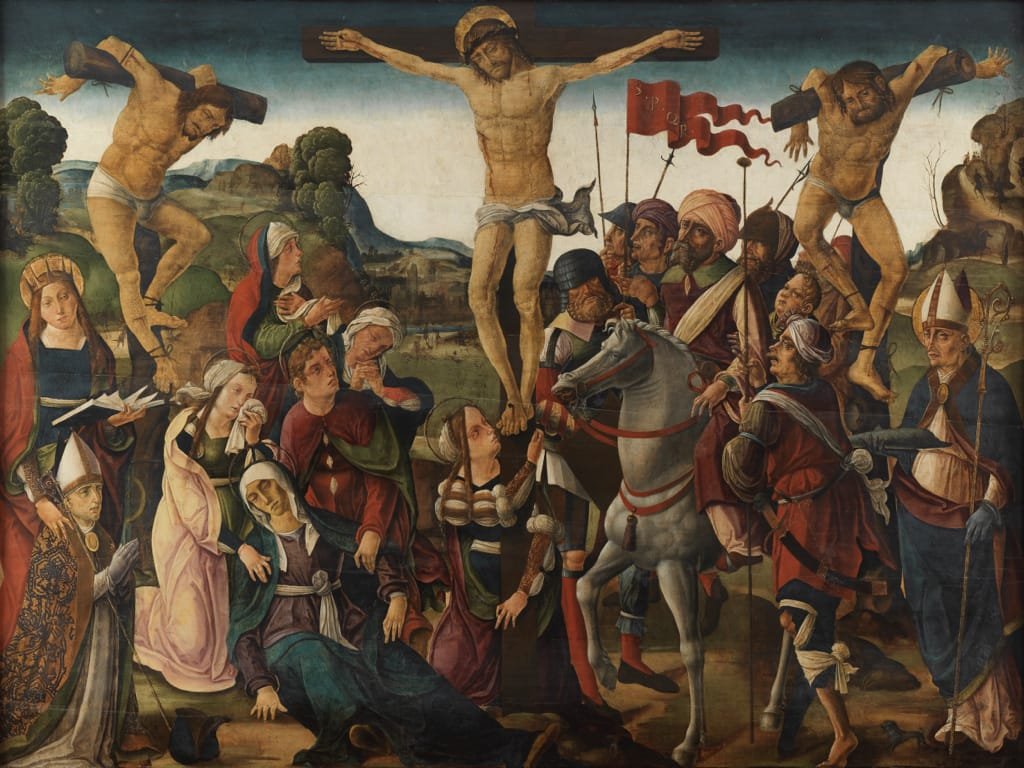
Unfortunately, only one of these elaborate paintings has survived intact to this day, the one that accompanied the marble tomb of Ulrich of Lichtenstein, Prince Bishop of Trento from 1493 until his death. The work, probably painted by a Nordic artist influenced by Venetian Renaissance painting, is divided into three overlapping panels: the upper frame depicts God as the Blessing Eternal; the central section shows the Crucifixion and Lichtenstein himself, on the left, kneeling and accompanied by saints; at the bottom, in the predella, two angels hold the epitaph recalling how the bishop commissioned the painting in 1504, a year before his death.
Although they are lacking explanatory inscriptions, the other two panels exhibited here certainly served a funerary function. Both patrons, namely the Canon Georg Nothaft and the Prince Bishop Johannes Hinderbach, are portrayed, with clothing and insignia that recall their social status and religious office, close to their coats of arms, kneeling as they pray to the saints for their holy intercession before God.
Trascrizione
The panel paintings you find in this room come from the San Vigilio Cathedral, where they were originally hung above the tombs of their illustrious patrons. This type of imagery, known as figurative epitaphs, was widespread in the German context and served to commemorate the deceased, who were portrayed kneeling in prayer alongside their patron saints. An inscription usually accompanied the painting, recording the name of the departed person, and forming an organic whole with the grave.
Unfortunately, only one of these elaborate paintings has survived intact to this day, the one that accompanied the marble tomb of Ulrich of Lichtenstein, Prince Bishop of Trento from 1493 until his death. The work, probably painted by a Nordic artist influenced by Venetian Renaissance painting, is divided into three overlapping panels: the upper frame depicts God as the Blessing Eternal; the central section shows the Crucifixion and Lichtenstein himself, on the left, kneeling and accompanied by saints. At the bottom, in the predella, two angels hold the epitaph recalling how the bishop commissioned the painting in 1504, a year before his death.
Although they are lacking explanatory inscriptions, the other two panels exhibited here certainly served a funerary function. Both patrons, namely the Canon Georg Nothaft and the Prince Bishop Johannes Hinderbach, are portrayed, with clothing and insignia that recall their social status and religious office, close to their coats of arms, kneeling as they pray to the saints for their holy intercession before God.