Trascrizione
Welcome to the Tridentine Diocesan Museum! This museum was one of the first of its kind in Italy, founded back in 1903 to preserve and promote the artistic heritage of the diocese. However, the diocese of Trento, until the beginning of the 19th century, was a very unusual one, a situation halfway between Church and Empire, led by a bishop who was, at the same time, also a prince. That is why in 1545 the city was chosen to host the Ecumenical Council, the first stop on our journey.
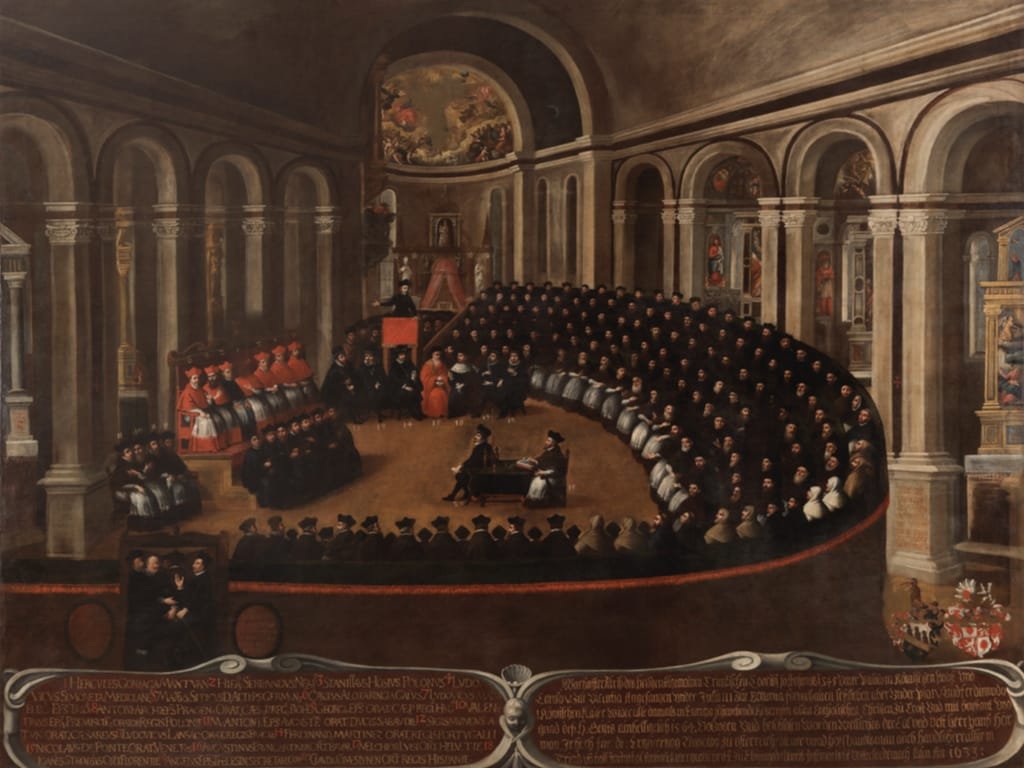
But let's start at the end! Yes, because one of the few depictions of the Council, to your left, was engraved and printed during its closing phase, in 1563. The image faithfully documents a typical council meeting, called a congregation, and was reproduced countless times by artists of the time and later. These included the Trentino painter Elia Naurizio, who in 1633 painted the large canvas to your right, in which you can read the names of the twenty most important participants among those depicted. Do you recognise any of them? Don't worry, probably even the inhabitants of Trento, then fewer than 8000, would have struggled to distinguish them among the almost 2000 prelates, theologians, delegates, and ambassadors who dwelt in the city.
The Council was convened by Pope Paul III at the insistence of Emperor Charles V to address the religious divisions caused by the Lutheran Reformation. The first phase of the assembly, from 1545 to 1547, took place mainly in the San Vigilio Cathedral, where the resulting decrees were officially approved. If you pass through the glass door, you can see a modern copy of a painting of the inside of the cathedral and the wooden structure that was specially built for the ceremonial sessions.
A second phase of work, between 1551 and 1552, did little to advance the dialogue between Catholics and Protestants but allowed the Church to resolve the important debate on the sacrament of the Eucharist, which I will talk to you about further in the section of this guide dedicated to painter Paolo Naurizio.
Work resumed in 1562 with a more substantial presence of national representatives, which led to the transfer of the congregations to the church of Santa Maria Maggiore, as illustrated in the print and painting at the entrance. The Council officially concluded on December 4, 1563.
Although neither the pope nor the emperor ever took part, the work of the Council was effective in formulating a more organic doctrine of the sacraments, in revising the liturgy, and in the disciplinary reform of the clergy, which strengthened the dioceses in their pastoral duties.