Trascrizione
Few people know that Bernardi's first achievement in the field of self-propelled vehicles was a legendary wooden tricycle with a Pia engine, now unfortunately lost, made for his son Lauro to ride around in the garden of the family villa. In 1893, he also designed and built what can be considered the first motor scooter for his son, which you can see in front of you. Bernardi mounted the Lauro engine on a single-wheel trolley which he attached to a bicycle. On the handlebars of the bicycle, he placed the systems for adjusting and controlling the vehicle, which worked by means of pneumatic or hydraulic transmissions. Unlike the motor cart, the bicycle on display is not an original, but dates from the 1930s.
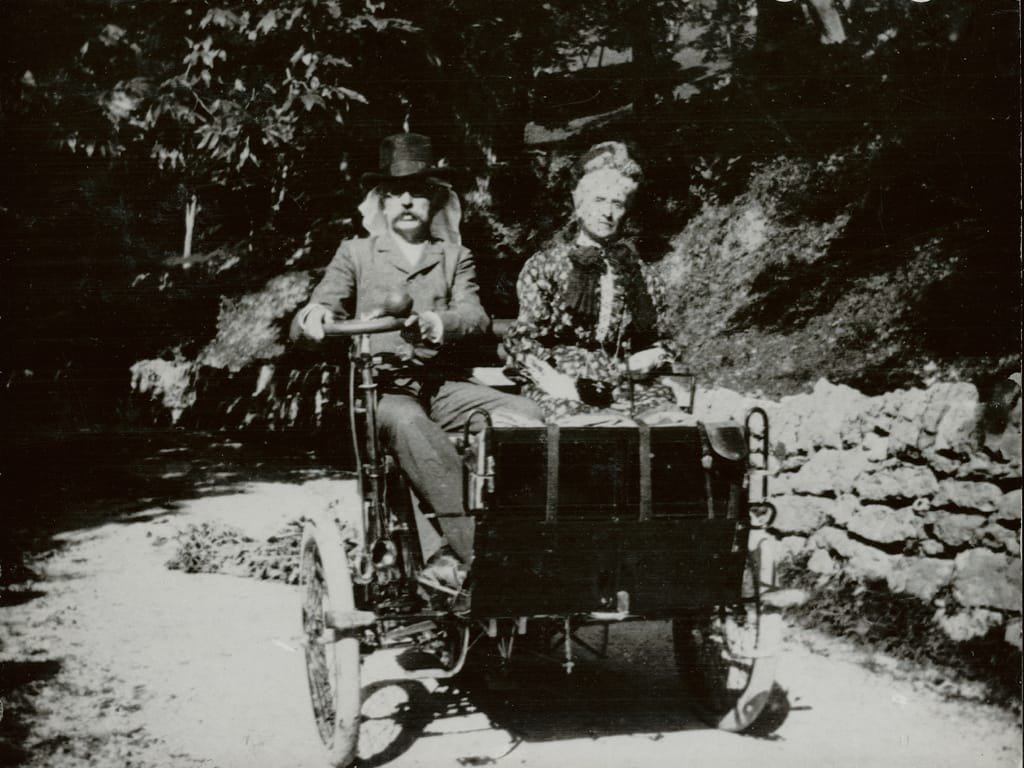
In the centre of the museum we find the creation that effectively consecrated Bernardi as the father of the Italian automobile. In 1894, the engineer from Verona created this three-wheeled car, the first vehicle fully designed in Italy. The car, with a Motore Lauro, had one driving rear wheel and two steering front wheels. In the years that followed, Bernardi built other three- and four-wheeled cars, with a total of around 100 examples. Up to now, five three-wheelers have been preserved in other museums, while this is the only surviving four-wheel prototype. Our car, which belonged to his son Lauro, is the only one that is still in working order and consists only of original parts, even though it has covered a good 60,000 kilometres, an enormous amount for the time. It bears the plate number 42-2, where 42 indicates the province of Padua.
We would like to share some of the original technical solutions of the Motore Lauro: the horizontal carburettor with pulverised petrol jet, where the level of petrol in the tank was kept constant by a special float; the incandescent ignition device, consisting of a platinum grid; the two-valve timing system controlled by rods, rockers and eccentric; the mechanical distribution of lubrication oil to the engine and transmission components; the centrifugal governor. The cylinder was cooled by forced water circulation activated by a fraction of the exhaust gases, while circulation of the air-tube radiator was initiated by small amounts of exhaust gases. The engine was also fitted with a silencer. The solutions Bernardi devised for the vehicle's mechanics were equally original, suffice it to mention the steering consists of 7 rods forming a double-wishbone for the rotation of the two steering pins. This innovation anticipated the differential and made it possible to solve the problem of the different trajectories of the outer and inner wheels in bends. On the car, the motion was transmitted by a chain, with a mechanical gearbox, sliding brakes and three gears plus reverse, which was engaged by resting the right knee against the steering column. Rope engagement was controlled by a conical clutch, while the brake, also a rope brake, was positioned on the secondary shaft. A shoe brake, located on the car's floor, acted on the rear wheel. The three controls of clutch engagement, rope brake and speed governor were controlled from a single handlebar, thus simplifying manoeuvring. The video in front of you allows you to see the machine's ignition system and see it in operation in the Department's garden.
To manufacture these cars, the company 'Miari & Giusti' was founded in 1894 on the initiative of Bernardi and two of his pupils, Giacomo Miari and Francesco Giusti Del Giardino. The company was located on Via San Massimo in Padua. In 1899, Bernardi took over the company and later founded the 'Società Italiana Bernardi', but it failed two years later in 1901. There were several reasons for the lack of success of what was Italy's first automobile industry: Bernardi was certainly not commercially minded, and the Veneto region did not have the right social, economic and political context for the development of this type of industry. This was due to the obstacles raised by the local landowners who feared losing their labour and seeing their power threatened.
Bernardi died in Turin, where he had followed his son Lauro in collaborating with FIAT. In 1891, Bernardi had been contacted by Giovanni Agnelli, who was completing his army service in the Veneto Region. Agnelli witnessed the testing of Motore Lauro and was highly impressed by Bernardi's genius. It seems that Agnelli had initially planned to start his car industry in Verona, but chose Turin instead, where he founded FIAT in 1899. It was therefore a missed opportunity for our region, as was often the case in 19th-century Veneto.
One last story before saying goodbye: on the 17th of July 1898, at the 'Concorso Internazionale di veicoli automobili', during the Turin-Asti-Alessandria-Turin motor race, Bernardi’s technician Antonio Nosadini drove the tricycle and won the 2,000 lire prize for the 'international speed prize', covering the 190 km route in 9 hours and 47 minutes, at an average speed of 19.42 km/h, despite a puncture and a broken gearbox. Bernardi's clear sense of ingenuity has unjustly fallen into oblivion, we do hope you have found a new appreciation for his genius during today's visit.
If you would like to learn more about other particular topics and learn more about Bernardi's inventions, please ask about booking a guided tour, our guides will be happy to share more and answer any questions you may have!
Don’t forget, that Bernardi’s car is still fully functional, ask about upcoming events organised by our museum, where you will have the opportunity to see the car running in the Department's garden!