Trascrizione
Bernardi's work must be put into context: the exploitation of the operating principles of engines had attracted the attention of most experimenters of the time. From a thermodynamic point of view, information on how to efficiently exploit the heat released by the combustion process of an air-fuel mixture was already known. In 1824, Carnot demonstrated that in order to increase the efficiency of a thermal machine, heat exchange with the hot source had to take place at a high temperature. For an engine, this could be achieved by preceding combustion by compression of the explosive mixture. Based on Carnot's observations, Clausius and later Kelvin and Planck formalised the second principle of thermodynamics. In 1862, the French engineer Beau de Rochas described the exact sequence of phases that made up the functional cycle of a four-stroke engine as we know it today. It is strange that such precise intuitions, especially the one suggesting that combustion should take place at the end of the compression phase, were met without interest nor immediately applied at this time, remaining practically ignored for almost twenty years. In 1877, when Otto himself filed a patent for his new engine, called the Viertakt-Vorgang, or four-stroke process, he put the claim of 'slow combustion' first, ignoring the thermodynamic advantage of the compression of the mixture inside the engine cylinder.
Curious enough, years earlier, while trying to improve the performance of the Lenoir engine, Otto had closed the exhaust of a small experimental direct-acting engine and compressed the inlet mixture by spinning the engine flywheel backwards to activate combustion immediately afterwards. The result was astonishing: the mixture ignited with such explosive violence that it caused the crank handle to rotate at a high speed. The experiment was repeated several times, but Otto, instead of investigating the thermodynamic reasons, was more concerned with the strong vibrations to which the engine was subjected, and proposed to contain them by pursuing the objective of slow combustion.
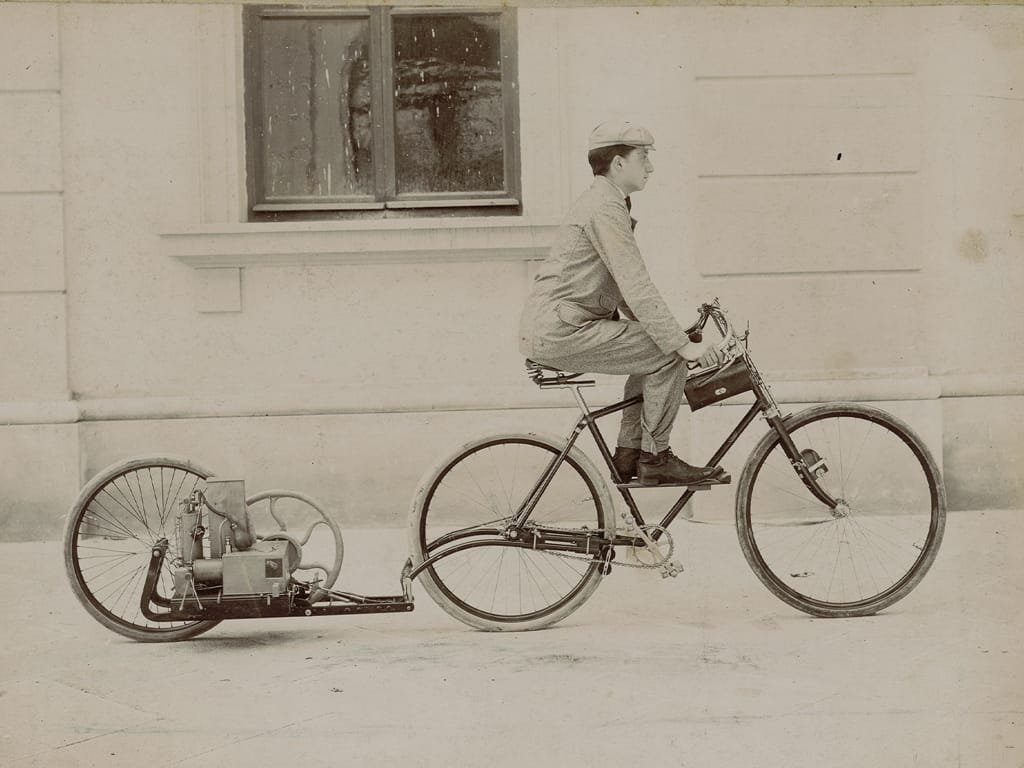
In 1886, as soon as Otto's patent expired, Bernardi began to focus his attention on the development of a four-stroke engine. The single-cylinder, horizontal-axis, petrol-powered engine, named Lauro after his son, is shown in front of you. The museum houses five Lauro engines, one of which was fitted to the prototype three-wheeled tricycle and one to the Bernardi car. Bernardi proposed particularly interesting innovative solutions for this engine, which we invite you to discover in the dedicated multimedia device.