Trascrizione
Just in front of you, is the Motrice Pia, the internal combustion engine invented by Bernardi. The idea of harnessing the explosive potential of gunpowder dates back to the late 17th century when scientists Huygens and Leibnitz suggested using the energy released by the gunpowder in the gun ports to move a piston and obtain mechanical work. However, it took more than a century before this idea was put into practice: in 1794 the Englishman Robert Street filed a patent for a single-cylinder reciprocating engine in which, halfway through the piston's stroke in the cylinder, a flame ignited a mixture of fuel oil vapour and air. The products of combustion would propel the piston to the end of its stroke and thus provide the engine impulse. The same principle inspired Frenchman Lenoir's direct-acting engine, built in 1860. In this engine, a mixture of air and gas was sucked in at a constant pressure almost equal to atmospheric pressure through a valve on the cylinder head. The subsequent expansion of the gases pushed the piston to the end of its stroke, the gas was then expelled through the exhaust valve, also located on the cylinder head. Although the thermal efficiency of the Lenoir engine was less than 10%, it was widely used in industry, but its use declined rapidly after 1865 due to competition from the Langen-Otto atmospheric engines, whose functional cycle was the one conceived in 1853 by Eugenio Barsanti and Felice Matteucci, the fathers of the first internal combustion engine. In this engine, the mixture was still sucked in at constant pressure, but ignition took place at a piston position closer to the bottom dead centre than the solution adopted in the Lenoir engines. In this case, no compression took place before ignition, and in the expansion that followed combustion, the gas pressure dropped below atmospheric pressure. During the combustion and expansion phases, the piston was disconnected from the crankshaft, so there was no engine impulse. However, the piston could reach the top dead centre more quickly, which improved efficiency by 12-14%. The driving phase occurred during the return stroke, when the piston, connected to the crankshaft, was subjected to a force given by the difference between the atmospheric pressure acting on the external surface and the lower internal pressure created inside the cylinder as a result of gas expansion. In Langen-Otto's solution, the connection of the piston to the crankshaft was rather complex and involved a rack-and-pinion rod and a free-wheel sprocket. The fast projection of the piston during the expansion phase and the subsequent engagement during the working phase was accompanied by strong vibrations and shocks, which limited the power of the engine, whose dimensions were also considerable.
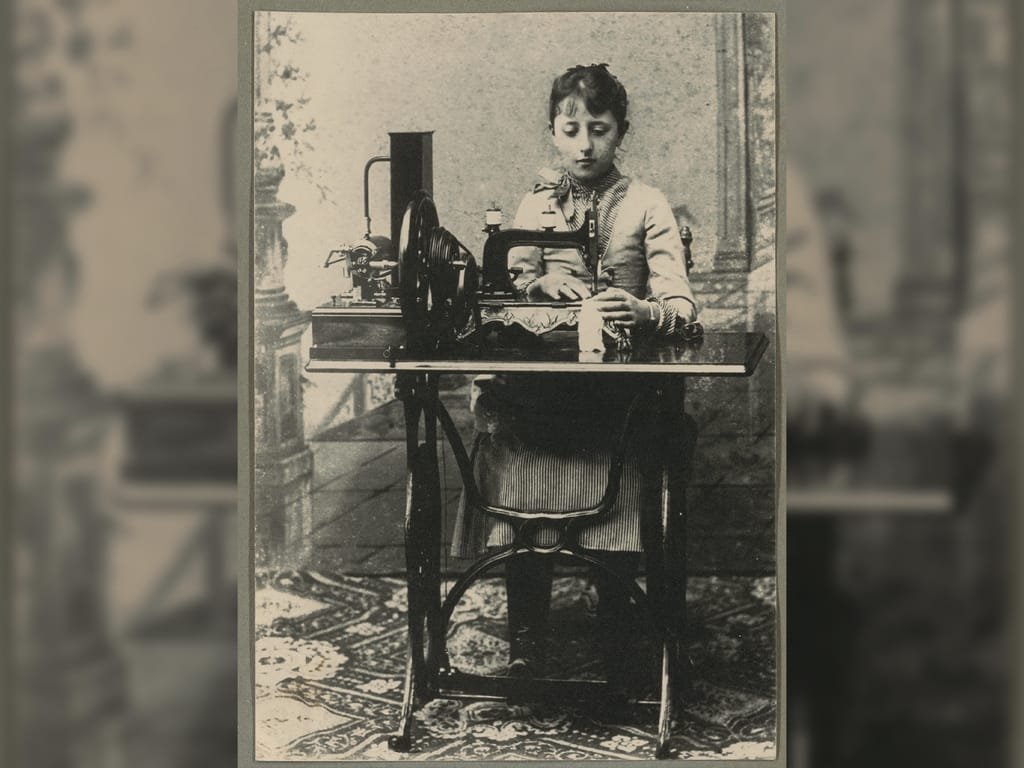
This is where Bernardi's studies in the field of internal combustion engines came in, leading him from atmospheric models to the creation of the Motrice Pia. According to Bernardi, who disagreed with Langen-Otto's solution, the mass of the piston must be as low as possible. The first atmospheric engine he built in Vicenza between 1872 and 1874 was a single-cylinder, horizontal-axis, single-acting engine. It had much lower consumption of illuminating gas than the German engine. In 1882, Bernardi proposed a mixed engine, naming it Motrice Pia after his daughter, which was both direct-acting and atmospheric that simultaneously used both principles of operation. This was undoubtedly an innovative solution from many points of view: from the ignition device to the automatic rotation speed regulator and the inventiveness of many of the components. Its first practical application was to operate Pia's sewing machine, as we can see in the photograph in the background showing Pia using it. In fact, one of Bernardi's main objectives was to create a small power motor that was easily transportable and suitable for the needs of small-scale industries at home. Motrice Pia could be used to drive a dynamometric machine, a small pump for domestic water supply, the fan of a small forge, and as a small lathe or a drill. In the Motrice Pia, which Bernardi also presented at the 1884 National Exhibition in Turin, the operating cycle was that of the atmospheric engine, but during the expansion phase following combustion the piston was longer free to proceed to the end of its stroke, rather is exerted its action on the drive shaft through a rotary thrust. Four Motrici Pia have been preserved in the museum: one gas-lighting engine and three petrol engines. The Pia petrol engine was the first European example of an engine that ran on petrol, designed to operate in places where there was no gas supply. In the dedicated multimedia device, you can learn much more about the various components of the engine.