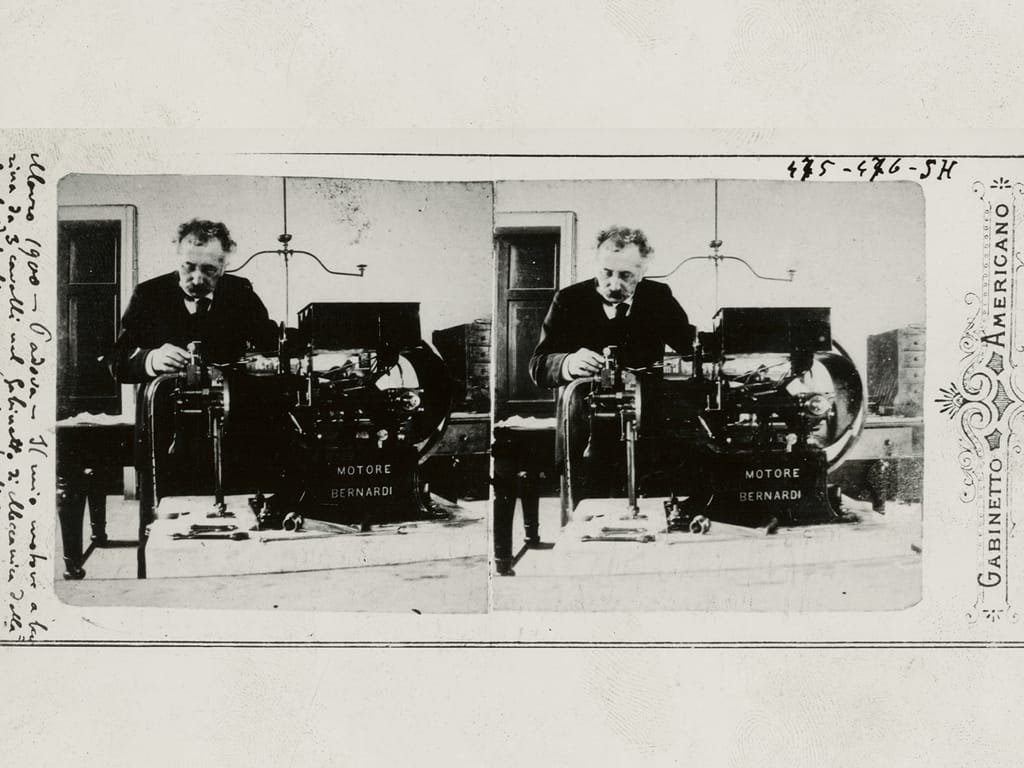
Trascrizione
Welcome to the Museo di Macchine "Enrico Bernardi", the pioneer of the automobile in Italy. The current layout of the Museum dates back to 2014, but in 1941 professor of thermic and hydraulic machines at the University of Padua, Mario Medici had already begun to display items donated by the Bernardi family, enriching Enrico Bernardi’s legacy to the Institute he founded. But who was Enrico Bernardi? Let's find out together!
Enrico Zeno Bernardi, pictured on the stained-glass window at the entrance to the Museum, was born in Verona on the 20th of May 1841. He showed precocious talent at an early age: out of pure passion and curiosity, he spent his free time in the workshops of the city's ironworkers while still in high school, acquiring the manual skills needed and free rein to his market his innovative abilities. In 1856, when he was just fifteen years old, he won the jury's 'Honourable Mention' at the Agricultural Exhibition in Verona, presenting a model of a locomotive and a steam engine. In 1859 he enrolled at the University of Padua and in June of 1863, at the age of 22, he received a doctorate in Mathematics. Throughout his university studies, Bernardi continued to work as an apprentice in the Rocchetti Foundry, the second most important foundry in the region. Bernardi's interest in machinery had always been well cultivated, his adjustment and forging techniques demonstrated a level of perfection in mechanisms and devices that he continued to produce throughout his career.
After completing his PhD, Bernardi remained in Padua as an assistant in the chairs of geodesy, hydrometry, rational mechanics and experimental physics. In 1867, he became a professor of physics and mechanics at the Reale Istituto Professionale Industriale in Vicenza. At this point he began an intense scientific activity on a wide variety of subjects: from mechanical construction to solid mechanics, from fluid mechanics to aerodynamics, from hydraulics to mathematics, from geometry to electricity, from astronomy to colour photography, displaying an incredible variety of interests supported not only by his natural talents but also by a strong cultural education.
In 1878 he was appointed professor of agricultural, hydraulic and thermic machines at the Regia Scuola di Ingegneria in Padua, where he founded and directed the Cabinet - later called the Institute - of Machines from 1879 to 1915. Very close to his family, he moved with his son Lauro to Turin, where he collaborated with FIAT until his death on the 21st of February 1919, at the age of 78.
Here on display is a model of an atmospheric engine, which works based on the pressure difference between the inside of the cylinder and the outside. Bernardi began to work on the practical realisation of this type of engine in 1870, at a time when there was a particular need for small engines as an alternative to the bulky and expensive steam engines. Bernardi's originality rested on his focus on developing a fast, light engine that was suitable for both industrial and road transport. In 1874, he produced the prototype of an atmospheric engine to meet the needs of small industries in the Veneto region.
In 1882, he presented the Prefecture of Padua with an industrial patent for a mixed atmospheric and direct-acting engine called Motrice Pia, named after his daughter. The machine was built in two versions: one running on gas and the other, the first in Europe, on petrol. For the latter version, Bernardi designed a carburettor with a constant fuel level, which was the first pulverised petrol jet carburation system. In 1886, when the patent granted to Nicolaus August Otto expired, Bernardi began to study four-stroke engines. The prototype of such an engine, named Lauro after his son, dates back to 1887.
The work of this brilliant engineer was appreciated by few, ignored by most, and often misunderstood outside Italy. This museum aims to shed light on the importance of the figure of Enrico Bernardi within the history of Italian and European engines, discovering in detail the marvels he left us.