Trascrizione
What you see in front of you is not the representation of the world as it was, but of the world to come. The distribution of landmasses as we know it is the result of the slow continental drift, which we may have mistakenly believed to have come to a stop. This movement is ongoing and the main cause for natural phenomena such as the progressive lifting of the Himalayan mountains and the gradual thinning of the Mediterranean.
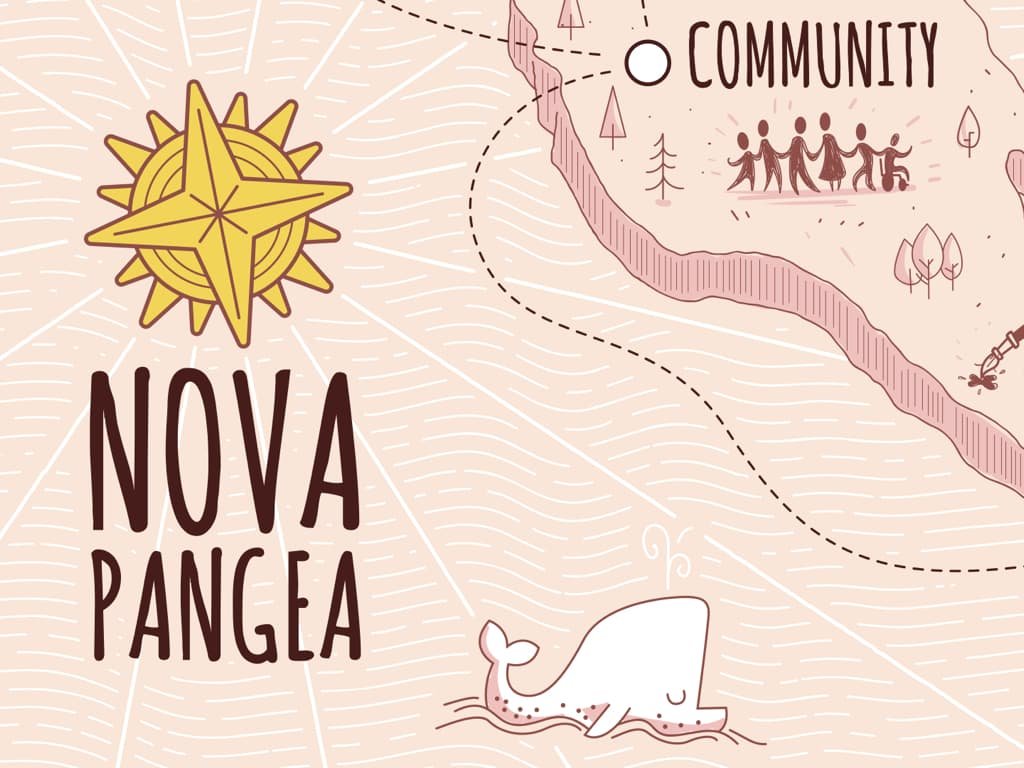
Therefore, the cartographical basis of this map does not represent the merger of continents of 300 million years ago, but rather the possible future configuration of a supercontinent within the next 250 million years, which scientists call Pangea Proxima or Nova Pangea. This map takes us to the future, in which geography offers an imaginary glance that illuminates one of the countless possible perspectives: a huge, unique continent where humanity will be called to cancel the distances and to overcome its profound cultural, social, economic and religious differences. To live together, we must rely on a shared set of fundamental values, inhabiting the cities that represent them on the map.
The future, though, is neither written nor drawn yet: we will have to decide together which values are the most important, creating the foundation of new cities, gradually starting from one that is still nameless, found at the centre of the map.
The Nova Pangea introduces us to a geography, where human experience lies in the middle of the map and is enhanced by a welcoming point of view for each and every one of us. Here the social and cultural dimensions of Geography express themselves, overcoming the eighteenth-century cartographic logic often still associated with this discipline. This is confirmed by the graphic scale displayed at the bottom on the right: the quantitative element which usually represents the anchor point between representation and reality (1 cm on the map equals 250 metres in the real world) is now shifted to the dimension of humanity, where we will be “measured” for our ability to empathise with other people and with other places.
The map, created by the cartoonist Isacco Saccoman, also opens up a new way of interpreting geography, in dialogue with art and other creative languages, which allows us to give shape to the subjective dimension of our relationship with the present world and stimulates our ability to imagine possible futures. Geography is also imagination!
The stairs you have climbed are a metaphor that describes the evolution of contemporary geographical thought. Continue on your visit by walking down the ramp to enter the main floor of the building through the large wooden door.