Trascrizione
We are now in the last room of the museum, dedicated to modern physics.
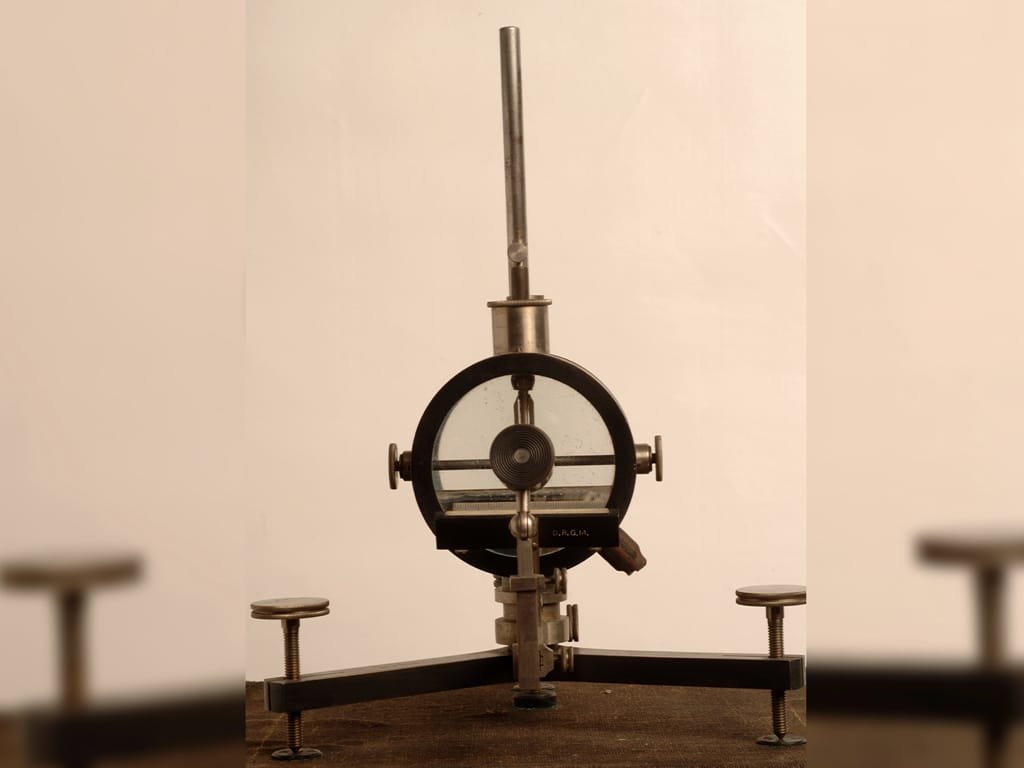
In the first showcase on the left, we see an instrument for the study of environmental radioactivity. Such researches were carried out in the early 20th century by Giuseppe Vicentini - the scientist who had carried out the first studies on X-rays in Padua! Studies of this type were widespread internationally at the time and led in 1911-12 to the discovery of a radiation coming from outside the atmosphere, the so called 'cosmic rays'.
Cosmic-ray research intensified everywhere from the end of the 1920s. Among the pioneers of this field was a young physicist, who was to become one of the giants of 20th-century physics, Bruno Rossi. We see him in the photos in the showcase below, with Millikan and Compton on one side, and Enrico Fermi on the right.
Rossi became professor at Padua in 1932 and introduced his new researches there. He also designed the particularly well-equipped Institute of Physics in Via Marzolo, which you can see in the photographs. In the showcase are several of Rossi's instruments and one of the large diodes of the 1-million-volt accelerator, which Rossi had built and which was to be the second in Italy. However, Rossi hardly had the possibility of using the new equipment, as he was expelled in 1938 due to the Fascist race laws.
At the end of the war, the situation of Italian physics was a complete disaster. Thanks to the new director, Antonio Rostagni, attempts were made to complete Rossi's accelerator - see the works in progress in the large photo... But the means were lacking, and all research activities were thus focused on cosmic rays, which allowed the study of elementary particles at a lower cost than accelerators.
The instruments left behind by Rossi proved invaluable. A few steps forward, the cloud chamber in the lower part of the showcase, for example, was improved and brought to the laboratory that was set up in 1950 at the Fedaia Pass, in the Dolomites. Several young physicists worked there. While they did not achieve great results, this time offered crucial years of training, so that the young physicists emerged ready to conduct research at an international level. This cloud chamber was therefore a failure for research - when it was used it was already obsolete -, but it is paradigmatic of the history of Italian physics, from the 'glorious' 1930s, with scientists like Rossi and Fermi, to the disaster of the post-war period, when means, knowledge and instrumentation were lacking, up to the rebirth of Italian physics in the 1950s.
Notice at the end of the showcase, two 'pearls' of Padua physics: above, the first bubble chamber that allowed to photograph a cosmic ray in Europe (photo in the background). Below, the first bubble chamber that was used at CERN in Geneva between 1958 and 1959.
Finally, in the large photo in the back of the room, among the young physicists of the 1950s, the first on the left is Gianantonio Salandin, who saved the Museum's collection in the years 1980-1990.
Finally, on the right, some parts of Giorgio Careri's cryostat, from the late 1950s, for researches on the properties of liquid helium at low temperatures. In order to obtain funding, Careri turned to the Research and Development Liaison Group of the US Army, based in Frankfurt, in 1956.
As you leave the room, take a moment to look at the showcase on the left. The objects remind us how, after the curative successes of radium, unscrupulous therapists and charlatans offered, from the 1920s to the 1940s, toothpastes, beauty creams and products of all kinds boasting the presence of radium... In the window there is also a container for preparing radioactive drinks at home... As a matter of fact, the real radioactivity in those products was usually very low or absent, partly because radium was extremely expensive. The risks of radiation were actually known to the scientific community since the 1920s.
Why then such a success? Perhaps because, as Nollet, one of Poleni's correspondents, wrote in 1746, “As soon as some news comes out in physics, curiosity gets hold of it, then it gives place to self-interest. What has been admired has to be useful”. We leave you with these words... a possible food for thought on the relationship between science and the market, and on the way our perception of science has been and still is shaped by very different factors.