Trascrizione
Magnetism and electricity are at the helm of this section, with jokes, sparks and various applications!
In the showcase on the right, we see for instance a lodestone with iron filings attached… there are also magnets, compasses and, at the bottom, a box of magnetic toys! ... Here, the instruments on display span the period from the 17th to the beginning of the 19th century.
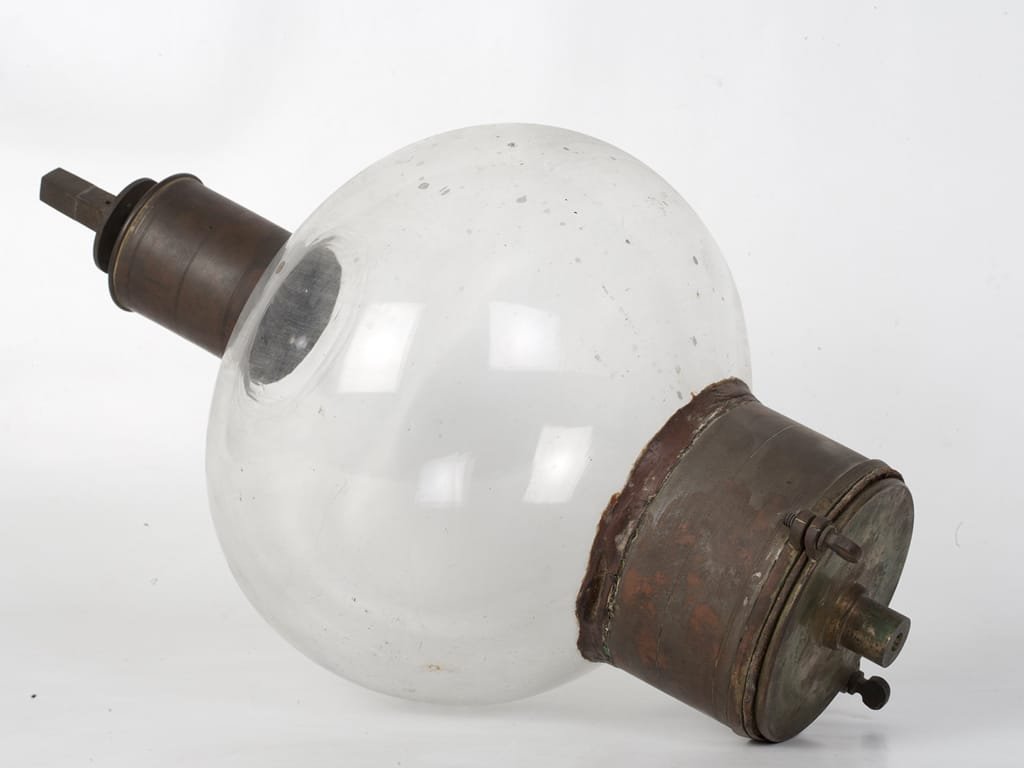
The following showcase on the left, as well as the large cylinder generator on the platform, take you to discover electricity in the 18th century..., a golden age when electricity became extremely popular not only in universities but also in Salons and courts. Glass globes or cylinders were spun and rubbed, creating spectacular effects. Notice the large glass globe in the showcase close to the generator: it was part of a generator similar to the one in the background print. Poleni purchased it for his electrical experiments. If you examine the documents inside the showcase, you will see that Poleni also attended “electric” evening meetings in Venice. He also personally experimented with electricity, as shown by the pulse measurements recorded before, during and after the electrification of... Marchese Giovanni Poleni…
Various jokes were also proposed in those years: you could, for example, hide your electric generator in another room, connect it to the guests' cutlery and watch the sparks fly! In the long showcase of the room, you will see other experiments of the time. In the first showcase, notice for instance the electric bells, or the little house used to test lightning rods…
We have been speaking of static electricity as of now. A radical breakthrough came in 1800, with Volta's battery, as we can see in the next display case. By stacking couple of discs of different metals, separated by a cloth soaked in acid, Volta obtained a continuous current for the first time. A new era was beginning... In the showcase below, we see various types of batteries and, in the background, the battery room of Paris Telegraph Office.
On the right, above, are two dry cell batteries invented in Verona by Giuseppe Zamboni. The central pendulum oscillated between the positive pole of one battery and the negative pole of the other battery... Zamboni's batteries could provide a low current but a good voltage, and were very long lasting. Just think that this pendulum, built in 1830, worked without interruption for more than 100 years, until 1937 - one of the batteries broke during the move from Palazzo Bo to the new Institute of Physics. Next to the pendulum, you can see a reproduction of a page taken from the lecture notes of one of Zamboni's students, who was professor of physics at Verona high school, now Liceo Maffei.
Zamboni sent this pendulum to Salvatore dal Negro, the professor of physics here in Padua, testifying to the collaborative relationship between the University of Padua and the other scholars of the region.
Also linked to Dal Negro is the electric motor behind you, placed in the foreground on the platform, with a horseshoe-shaped electromagnet and a magnetic bar that could oscillate between the ends of the electromagnet. This is one of the very first models of electric motor ever invented! It was designed by Dal Negro in 1831, and you have before your eyes a prototype, unique in the world. As a matter of fact, this motor was neither widespread nor followed up at the time, due to the lack of local workshops that could develop and disseminate the instruments invented at the university - such workshops had actually no chance of flourishing in a region based on agriculture, with a scarce and short-sighted bourgeoisie, and a government that had little interest in investing in science and technology.
To the left of Dal Negro's motor, you see in the background a powerful electrostatic induction generator, which produced tens of thousands of volts. It was made and used by Augusto Righi, an important Italian physicist who taught in Padua in the 1880s. With this generator and the batteries of Leyden jars, i.e. condensers, that you see in the foreground, Righi obtained very long sparks on sheets of glass, which you see in the photo on the left.
Now turn a quarter of a turn... and you will find another of Righi's instruments in the upper part of the display case: it is a selenium photocell, one of the first ever invented, that Righi designed and had built.
The arc lamps in the lower part of the showcase were acquired by Francesco Zantedeschi, physics professor here in Padua in the mid-19th century. When a current passed, a very bright arc was produced between the two carbons. Having seen demonstrations of electric lighting in Paris, Zantedeschi organised a public demonstration with an arc lamp in Padua, in the courtyard of Palazzo Bo, in 1853. It was the first public demonstration of electric lightning in the Veneto and one of the first in Italy.
Because of the bright light they produced, lamps of this type were used for the electric lighting of streets and squares in the second half of the 19th century. They were not, however, suitable for indoor lighting, where incandescent bulbs became widespread, clearly visible in the Parisian flat of the wall print, and displayed in the next showcase....
The large display case that follows shows the explosion of scientific instrumentation that characterised the second half of the 19th century. Why so many instruments to measure current? Electricity certainly underwent great developments at that time and entered everyday life with lamps, telephones and telegraphs. However, demand for apparatus also came from industry, from university laboratories, often expanded in those years for the use of students, and from the Physics Cabinets of new secondary schools. There were also Universal Exhibitions, in which States displayed their national "ingenuity" through new inventions. New and old scientific instrument companies thus multiplied their products, especially in France and Germany. You can see pavilions of French and German instrument-makers in the background of some showcases.