Trascrizione
We are now in the room dedicated to hydrostatics and pneumatics, disciplines that originated in Greek antiquity. Pneumatics underwent major developments in the 17th century. We invite you to discover some of its aspects by trying out the experiments on the display stand to your left.
First press the switch on the left, you will hear the sound of the bell under the glass. Then press the switch on the right: a vacuum pump starts up, gradually removing air from under the glass bells. First let’s see what happens on the right.
The largest ball of the scale moves downward. Why? Because the internal pressure decreases and so does the upward Archimedes force exerted on the ball (the same force that enables ships to float!). Now observe the balloons.
You see that the closed balloons are inflating. Why? As the pressure decreases, the air inside the balloons can expand. Notice that the open balloon does not inflate! And what happens in the left-hand bell?
If you try to press the left switch again, do you still hear the bell? Much less, if at all, because the sound is linked to the vibrations of the air. Now observe the liquid in the left tube.
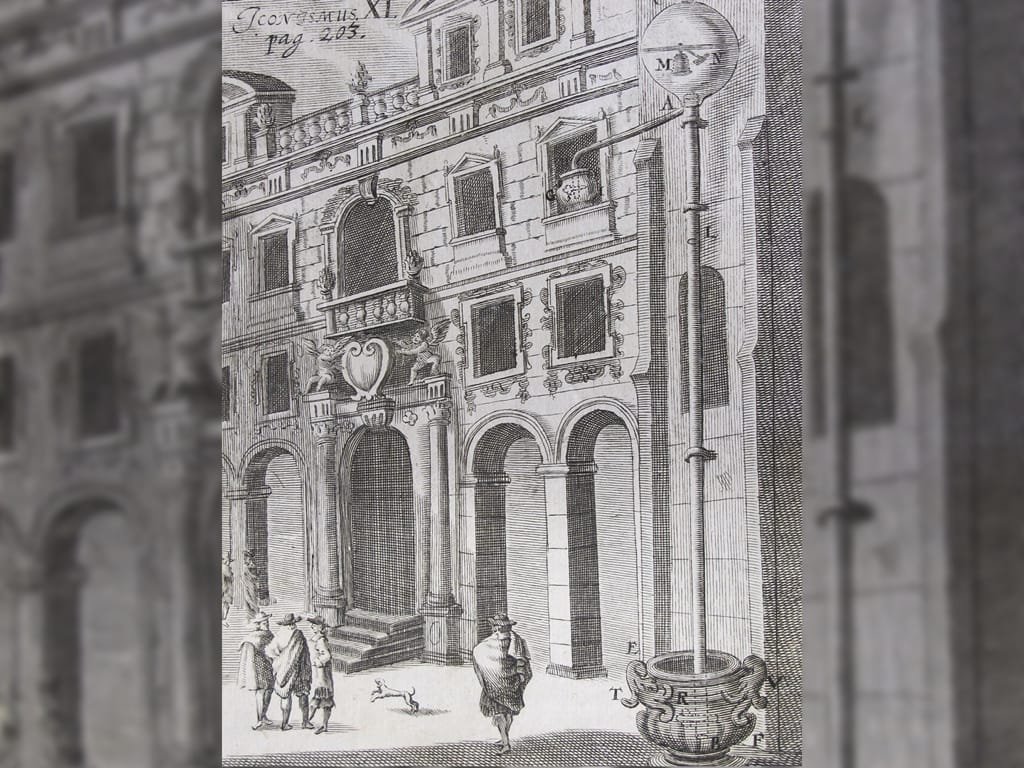
It is going down... because the action exerted by the air on the liquid in the vessel is decreasing. In fact, we live 'submerged at the bottom of an ocean of air', as Torricelli wrote. Torricelli, who was Galileo's last pupil, discovered the action of atmospheric pressure in 1644.
All these experiments were classics in physics lectures in the 18th and 19th centuries. If you now turn towards the terraces, you will see two vacuum pumps, one from the 18th and the other from the 19th century. It is under the glass bells of these pumps that the experiments you have just seen were carried out. At the end of the room, there are more vacuum pumps from the 19th century, which were used to achieve increasingly higher vacuum levels.
Let us now have a look at a couple of objects in the showcases. First of all, in the first showcase on the left, the large 18th-century brass instrument on the right is a so called “Hero fountain”. Poleni, in front of his students, poured water into the funnel, and a tall jet of wine was expelled upwards from the small pipe at the top. Was he turning water into wine? No, of course not. This was due to the transfer of water and air from one container to the other, thus compressing and expelling the wine contained in the upper container. Here again, an example of the typical spirit of 18th-century physics lectures: spectacular and entertaining.
In the same vein, Poleni poured wine into the two beautiful Tantalus glasses in the foreground. They filled normally, but when they were almost full, the liquid began to leak from the spouts underneath and it was impossible to fill them. Why? Because a siphon is hidden in the centre and, when full of liquid, it empties the glasses. This experiment caught the attention of students, who were then provided explanations about siphons and the action of atmospheric pressure.
Now proceed along the showcases. In the third showcase, notice the beautiful 18th-century glass instruments, lying (on the left) or suspended; some have glass scales... They are aerometers, for measuring the density of liquids and solids. They are the direct ancestors of the instruments used today to measure the alcohol content of wines and grappa.
We now invite you to move to the next room.