Trascrizione
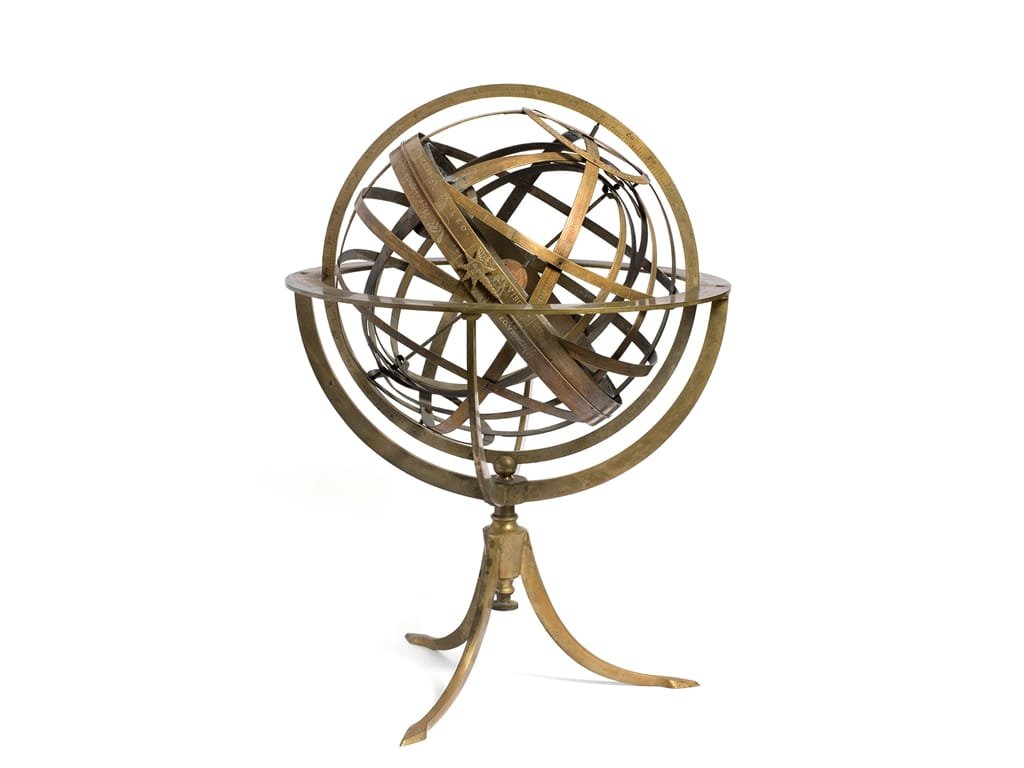
Here we find ourselves in the heart of the Renaissance! In front of you, on the left, is an extremely rare armillary sphere, made up of three concentric spheres, with the motionless Earth at the centre and the Sun revolving around the Earth. And then an astrolabe signed by Arsenius in Leuven in 1566. Leuven’s instrument-making workshop was among the most prestigious in Europe. Arsenius built instruments for Philip II of Spain, among others. The astrolabe is a two-dimensional model of the Universe - the serpentines you see correspond to stars. Exquisitely crafted, the astrolabe on display is unique because the projection extends south of the Tropic of Capricorn. To the right of the astrolabe, we see a number of sundials dating from the 16th to the 18th century...
The print on the left, inside the display case, describes the use of an astrolabe to measure the height of a tower. In the Renaissance, through mathematics, instruments transformed various arts, such as navigation, land measuring or time-telling. It was the time of the so called “practical mathematics”. In the showcase below, on the right, you can see proportional compasses, widely used in the art of warfare to determine, for example, the weight of a cannonball directly from its diameter.
From the Renaissance onwards, mathematical instruments were included in the so called “cabinets of curiosities”, the collections of the time - as can be seen in the reproductions of Flemish paintings displayed on the left.... Because of their application in various arts, instruments acquired extraordinary prestige during the Renaissance: they became symbols of erudition... and power.
As prestigious as instruments were, they did NOT convey knowledge. The study of nature, natural philosophy, was entrusted to philosophers, who mainly relied on ancient texts. The turning point came in the 17th century, with the Scientific Revolution, inaugurated by Galileo Galilei. This is described in the showcase behind you, where you can see the bust of Galileo. Let us remember that Galileo spent 18 years here in Padua, from 1592 to 1610. It was here in 1609 that he made his first observations with the telescope, studying for instance the mountains and valleys of the Moon. The study of nature thus began to be based not only on texts but also on observations, measurements and experiments. Instruments became central to scientific research.
It should be noted that Galileo Galilei was a professor of mathematics in Padua, and it is no coincidence that he developed an instrument such as the proportional compass; you have just seen some compasses in the showcase under the astrolabe. It was precisely with Galilei that practical mathematics, with its calculations, measurements and observations, began interlinking with natural philosophy: modern science, as we know it today, was to be born. Science and technology started merging, a true revolution. Several unique or very rare instruments are displayed in the showcase: on the right, a lens made by the famous astronomer Geminiano Montanari in 1676, and below, the microscope signed by Eustachio Divini in 1672, unique in the world.
Now move to the left, past the pile driver. We learn that until the end of the 17th century, European universities largely went on basing their teaching on ancient texts. Only at the beginning of the 18th century, new lectures based on experiments and demonstrations became popular. They were centred on the area of the study of nature that we now call 'physics'. These so called 'experimental philosophy', or 'experimental physics' lectures, were very successful and soon spread throughout Europe in Salons, courts and universities. They brought forth the development of new instruments and the creation of Cabinets of Physics. The Republic of Venice established a new chair of experimental philosophy in Padua in 1738 and assigned it to Giovanni Poleni in 1739. Poleni held his new lectures at Palazzo Bo, in the theatre he had specially built. For these lectures, he created a renowned Cabinet of Physics, which over the years his successors would gradually enrich. We now invite you to enter this Cabinet of Physics....
In front of us, in the showcases, we see mechanical instruments, for the study of equilibrium and forces, while some steps forward, on the corner platform on the left, devices for the study of motion are displayed. Note the first instrument on the platform: a small ball was dropped along the track; it crossed all the rings, which are fixed along a parabola... This visually showed how projectiles follow a parabolic motion, as Galileo had discovered. Such instruments thus demonstrated the laws of physics in a direct and often spectacular manner: this was the spirit of 18th-century lecture-demonstrations.
Next on the platform, please notice the two beautiful instruments further to the left: one that demonstrates the law of falling bodies, discovered by Galileo, and the other for studying the motion of bodies along a cycloid. Both were made for Poleni by Philippe Vayringe, the 'blacksmith turned philosopher' of the Lorraine court. Vayringe's instruments were admired by none other than Voltaire! In the background, an 18th-century Cabinet of Physics, as Poleni's cabinet must have looked like.
Now please take a look at the last showcase on the left. At the bottom, you see a double cone: when it is brought at the base of the track, the double cone always appears to roll upward to the highest point... it seems to defy the laws of mechanics, but the centre of gravity of the double cone is actually descending... A tool meant to amaze students and the public... but all such "mysteries" were then explained as clearly as possible. This is the 18th century, this is the Age of Enlightenment.
Finally, behind you, observe a pantograph, an instrument that Poleni used to study muscles with his friend Morgagni, the well-known physician. Yet another example of the interdisciplinary nature of this collection.
We now invite you to move on to the next room.