⚠ Questo contenuto non è disponibile nella lingua richiesta (DE): lo stai leggendo in EN.
Trascrizione
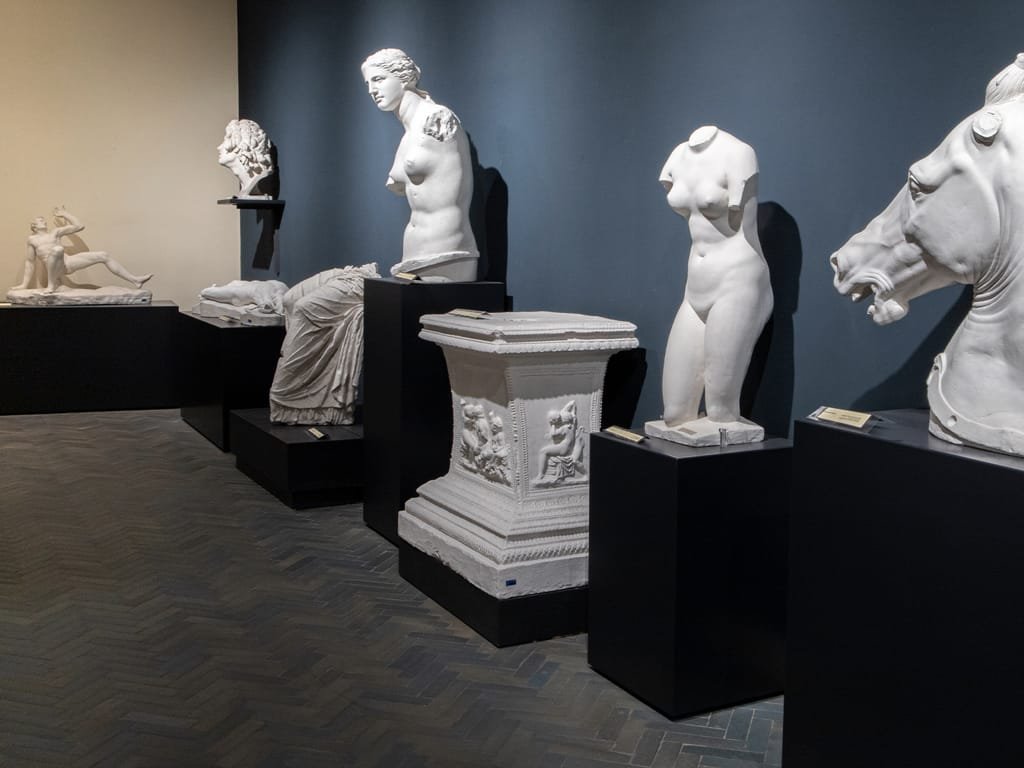
After passing the cast of the Medici-Riccardi horse head, the works of the third stage begin, the Hellenistic art (323 -30 B.C.). In this section there are many casts from sculptures from the National Archaeological Museum of Venice, brought here for educational purposes: among these, note the Grimani altar, perhaps a base for a statue, and the two casts of dying Galati from Roman marble copies of the statues of the second donary dedicated on the acropolis of Athens by a king from Pergamon between the end of IIIrd and the half of IInd century B.C.. From the Louvre Museum comes the partial cast, without the drapery of the lower part, of the Venus from Mylos. Below, walking through the gallery located behind the large hemicycle with the Hermes, there are some casts of busts such as the so-called Seneca, the Homerus and the Chiaramonti Poseidon, the originals are all ancient copies of Hellenistic works. At the center of the short gallery you will find the cast of the Spinarius: the ancient bronze is in the Capitoline Museums in Rome. This is followed by the famous Laocoon group represented here by a small cast. It was made on the version of the statue as it appeared before 1905. Proceeding to the left, the fourth and last stage dedicated to Roman sculpture begins at the corner. The third information point is also located here. After the cast of an official portrait of Emperor Augustus and two archaistic sculptures of hunting Diana, some reliefs follow on the adjoining wall, including a sarcophagus slab with a battle scene near the ships. The brief review is closed by the cast of an altar from Villa Albani, in Rome, dated to the Hadrian period, originally perhaps it was a base for a statue, decorated with a procession of archaistic divinities including Ceres, recognizable by the ears and poppies held in her right hand. After passing the emergency exit, find three sarcophagus fronts exposed on the wall, reproduced in 2012 by digital technologies that do not require contact with the find and therefore prove to be particularly useful in the case of fragile works with inconsistent surfaces. In this group, note the larger relief below, which is the reproduction of part of the front of a sarcophagus depicting the myth of Phaeton: the original is kept in the Pietro Canonica Museum in Rome and is dated to the early fourth century. A.D.
Beyond this point you will find other plaster casts on display, placed outside the chronological itinerary mainly for conservative reasons: they are housed in the southern sector of the room, in the transit area, equipped with windows and separated from the rest of the exhibition by an equipped wall. In front of the equipped wall, between the windows, there is the video station. On the right, near the exit of the Museum, there are some casts of modern and ancient busts including that of the so-called Vitellius Grimani. The original is in the National Archaeological Museum of Venice and is an ancient work even if the identification with the roman emperor Vitellius is now outdated. In the Renaissance the type of the so-called Vitellius enjoyed great success and was reproduced in many ways both in painting and in sculpture. A painted plaster sculpture is also present in this museum and you have already admired it in the Mantova Benavides room.
The visit to the Museum is over: on leaving, you can take a look at the educational exhibits contained in the equipped wall. To discover further stories and secrets of the archaeological heritage on display, book a guided tour of the museum. We are waiting for you! Thank you.