Trascrizione
The room n. 8 houses the Etruscan productions, in pottery and bronze, datable between the ninth and third centuries B.C. Among the oldest finds, you can see on the right of the showcase some hand-shaped wares of the Etruscan-Lazio area, dating back to the nineth -seventh centuries B.C.: bowls with a single handle, cups, round vases and amphorae, variously decorated. A plate of Faliscan (southern Etruria) ware, datable around the middle of the seventh century B.C. shows engravings of fantastic animals deriving from the orientalizing tradition with decorative themes originating from the eastern Mediterranean area.
There are also several objects in bucchero, a typical Etruscan ware, characterized by the black colour of the terracotta. Among the forms, linked to the banquet, there are cups, kantharoi (a kind of cup with raised handles), chalices and jugs. The black bucchero is flanked by the gray one from the sixth century B.C.: in the showcase you can appreciate a series of jugs, a small amphora and a kotýle (a kind of bowl).
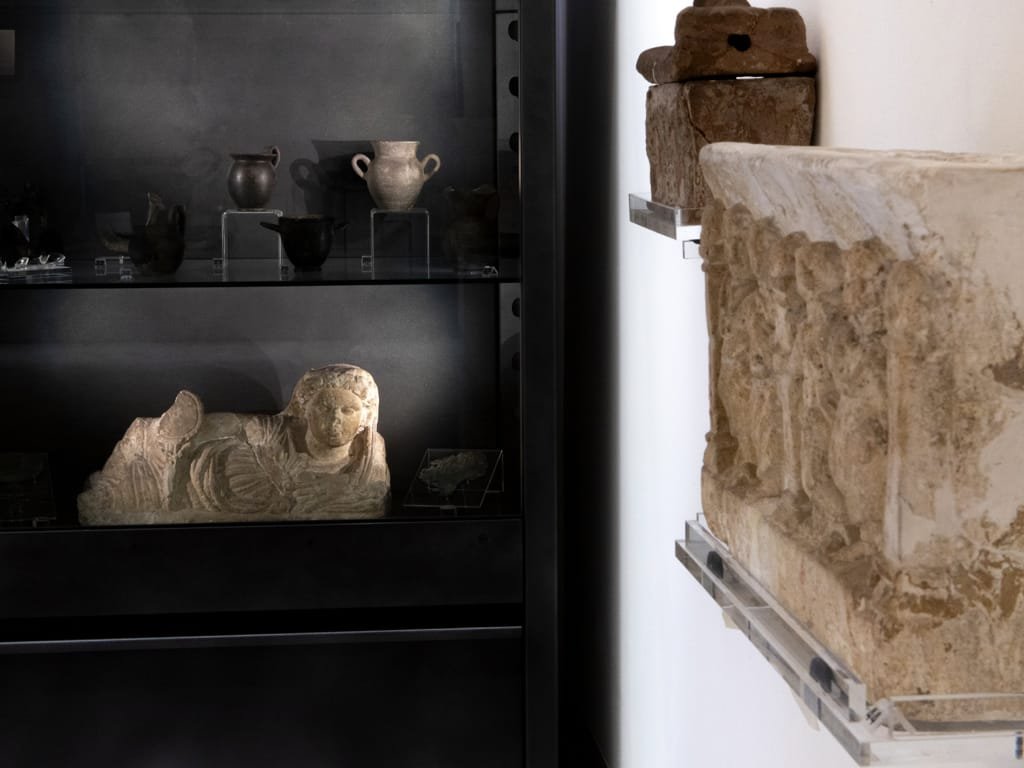
Among the later imitations of Greek ware there is a group of vases produced in the upper Adriatic area, datable between the end of the fifth and the third century B.C., including both pottery completely painted in black and figured vases: these artifacts come from two burials of the necropolis of the ancient town of Spina, near Comacchio. On the left of the showcase, from the same context from Spina, are two north-Etruscan bronze candelabra datable between the fifth and fourth centuries B.C.: the bases of both of them are characterized by the usual tripod with lion legs, while the most complete item is characterized by the presence of an all-round figurine of discobolus, placed at the top. Also in bronze, in the lower right shelf of the showcase, notice two mirrors decorated with engravings and datable between fourth and third centuries B.C.: in the oldest one there is a winged figure advancing from the right, perhaps one of the Lasae of Etruscan mythology; the most recent mirror instead presents two figures faced, probably the Dioscuri, the divine twins of Greek mythology. On the right wall of the room, you cannot escape two funerary urns intended to contain the ashes of the deceased inside the parallelepiped case. Both are datable between second and first centuries B.C.; the largest item, in tuff stone, has a farewell scene on the front of the case while the smallest urn is in terracotta and decorated with the door of the Underworld. It preserves traces of painting and bears engraved on a side the name of the deceased. The lids of both urns are shaped like a reclining female human figure, a representation of the deceased.
The finds of the Etruscan section have reached the museum along multiple routes: a substantial group derives from the acquisition in 1952 of a small part of the collection of Evan Gorga, a collector and tenor from Lazio who at the turn of the nineteenth and twentieth centuries AD collected over 150,000 objects of various ages and nature and ceded their assets to the State in 1949 after falling into ruin; the finds from Spina come from a recovery by the Carabinieri , a sort of State police of the Italian Army, that took place in the fifties of the past century; finally, a third group refers to the collection of Eugenio Neumann from Trieste, who certainly had a privileged antiquarian channel with Tuscany and in particular with Arezzo.