Trascrizione
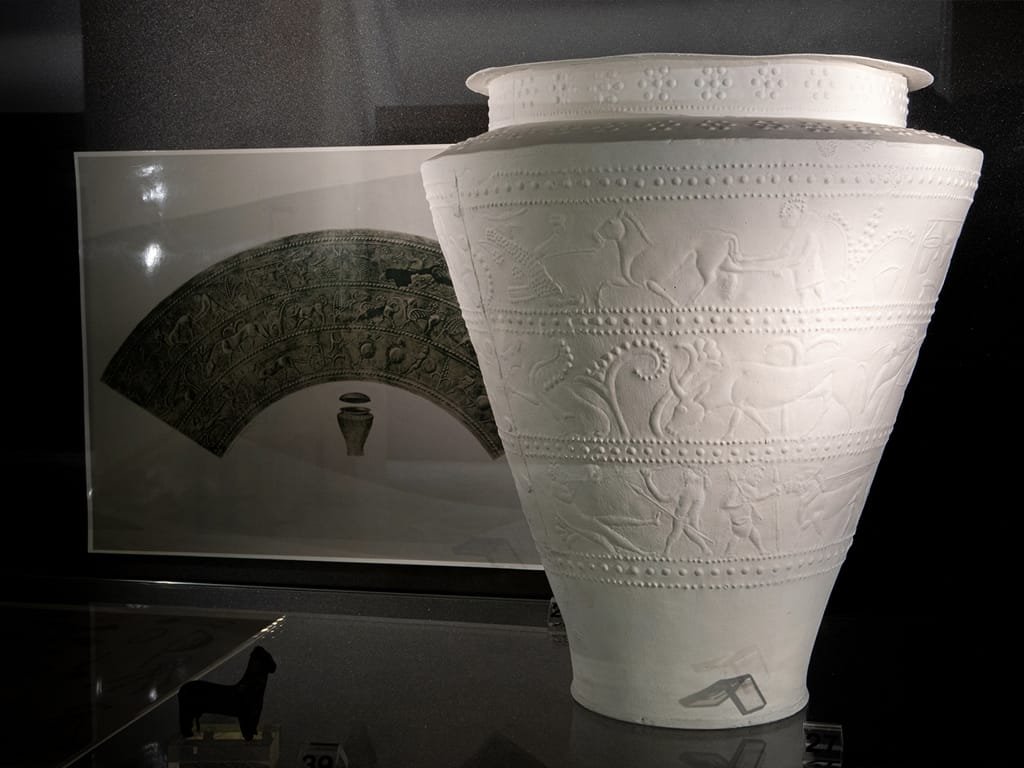
The rooms nos. 5 and 7 house collections of the Ancient Venetians culture, respectively from the town of Este and that of Padua. In the first room you can see mainly finds from Este, dating from the eighth century. B.C. and the second / first century B.C. Among the oldest items, dating back to the eighth-seventh century B.C., a boot-shaped vase is undoubtedly distinguished, found in a tomb of the necropolis of Morlungo in Este. Among the other vases on display referable to this most ancient period, we must mention cups, bowls, jars and glasses, also a vase with a truncated cone body. This latter takes the shape from a bronze vase called situla, one of the most characteristic vases of Atestine craftsmanship: it was an inverted truncated cone vase, equipped with two movable handles and with a lid, often destined to act as a cinerary. The exhibition also features a modern cast of the Benvenuti situla (625 BC), undoubtedly the best known example of this particular kind of vase, which has been defined as "the epic poem of the Venetian people".
Among the ware datable between the sixth and fifth centuries B.C., made on a lathe, there are the vases with a typical decoration with bands painted in red and black colours, delimited by raised cords, also for the most part they belong to the necropolis of Morlungo.
The bronze ornamental objects that you can observe on display can be referred to these two most ancient phases: pins, fibulae, armillas and a belt hook decorated with engraving. There is also a precious cylindrical element covered in gold leaf and some necklace elements made of glass paste. A knife and an ax with bronze wings refer to daily activities such as hunting or procuring wood; to the female sphere, on the other hand, reels and spindles in terracotta, used for spinning, are traced back.
In the lower portion of the display case you can see some vases in gray ceramic, a ceramic class that distinguishes the last production phase of the ancient Venetians ware between the fifth and first centuries B.C., together with a reinterpretation of some typical forms of the Etruscan-Po area or of Greek black-painted pottery. In the lower right corner you can see a significant group of small and in some cases miniaturist pottery. Although of uncertain origin, it is most likely attributable to one or more votive contexts of the second Iron Age. Certainly the sphere of the sacred items also includes some contemporary bronzes, depicting male figures and horses.
In room n. 7 the objects on display belong to the Venetian necropolis of Padua and, specifically, to that of University Sports Center “Piovego”, a place located east of the ancient urban center, on the right bank of an ancient branch of the river that crossed the city, an area where the river Piovego still flows today. Datable between the sixth century and the middle of the fourth century B.C., the necropolis has been known since the 1960s and was systematically investigated by the University of Padua until the end of the 1980s.
Typical of this necropolis is the cremation tomb inside large food vessels called dolia in which the ossuaries and the grave goods were placed; you can appreciate one of these kits in the display case, dating back between 575 and 525 BC. and belonging to a tomb that housed a deceased of 40-60 years.
In addition to other typical artifacts from the pre-Roman funerary items of Padua, a bronze sheet knife sheath with a figured frieze that recalls the style of situla art, an Attic skyphos from the circle of the Painter of Hàimon, datable between the end of the sixth and the first half of the fifth century B.C. and coming from a ritual deposit, and finally a porphyry pebble with a Venetian inscription from the fifth century B.C. are on display here. The latter does not seem to have been a sign of a tomb: it had to serve as a "memorial monument", perhaps reserved for a prominent member of society or a family group.
Turning your gaze to the side wall of the room, you will finally come across a funerary stela, known as Loredan II. The limestone slab can be dated between the end of the fourth and the beginning of the third century B.C. and depicts a warrior on horseback going to the right side. It was found along the Piovego river, in 1933, in the area of the Institute of Pharmacology.