Trascrizione
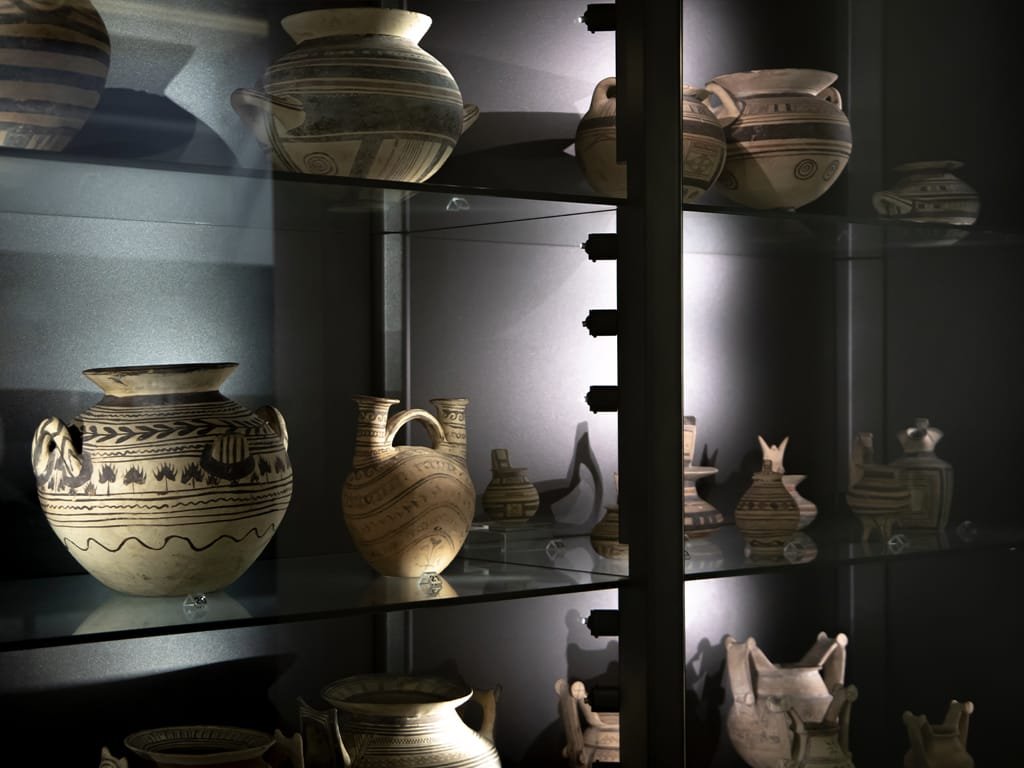
After the visit of the two rooms dedicated to Egypt, room 3 displays the collections of ancient Apulian ware. The items you see in the showcase are part of a larger donation by the spouses Michelangelo Merlin and Oplinia Hieke. The Merlin couple had in their collection a remarkable amount of Geometric Apulian ware, mostly large in size and of considerable decorative commitment. The repertoire on display is representative of the three main production areas into which the Apulian culture district is divided, namely the Daunia (northern Puglia, up to the Ofanto valley), the Peucezia (corresponding to most of the current province of Bari) and the Messapia (extended between the southern Murgia and Salento). These artifacts, datable within the chronological span that from the eighth century goes up to the fourth century B.C., have shapes and a decorative apparatus resulting from the technical and cultural mixtures between local traditions and the influences of Greek colonization.
in the central shelves of the showcase, among the group of the Daunian ware there are a series of vases, datable between the middle of the sixth and the beginning of the fourth century B.C.: these large vases, intended to contain, are constantly present in the funerary objects, typically flanked by the attingitoi (vases to draw on), intended instead to pour; their decorations are geometric and phytomorphic, but there are also plastic insertions, such as animal heads and busts placed between the loops. Even in the attingitoi, which you see exposed at the bottom left, there are anthropomorphic patterns that decorate the high horned loops.
The Peucetian ware here exposed date between the seventh and sixth centuries B.C.,also in this case there are globular vases on foot, with geometric decorations in bands, rhombuses and swastikas. A vase is decorated with birds inserted in the space between the loops; similar motifs are painted on an askòs, a vase with the function of ointment.
The exhibition ends, on the right of the showcase, with a series of trozzelle, a Messapian ware: these vases, made from the seventh century but produced in particular between the fourth and third centuries B.C., had a main funerary destination and is believed to have been intended for high-ranking female figures; the name of this particular amphoric shape derives from the expression that in local dialect indicates the "wheel", as pairs of diskettes were applied to the base and top of the ribbon handles, which develop slender well beyond the edge of the vase, and then rejoin it forming an acute angle at the apex.
The objects you see on display in this room are not only belonging to the Merlin collection: the showcase is completed with finds pertinent to the purchase of Neumann, a collector from Trieste who sold his collection to the University of Padua, albeit for consideration, a significant number of Apulian artifacts, only minimally exposed, as they are smaller and worse preserved than those of the Merlin collection.