Trascrizione
After leaving the Mantova Benavides room you are now in room n.1 which, together with n.2, contains the Egyptian collections. From these two rooms begins the sequence of the didactic archaeological rooms that make up the second section of the museum. It develops in 12 rooms for over 20 meters. From this point, moving towards the center of the corridor and looking towards the following rooms, you can admire the extraordinary spectacle of the 12 rooms arranged by Ponti in perspective escape: the walls seem almost like theatre wings, sculpted by the light that enlivens the modularity of the architectural scheme.
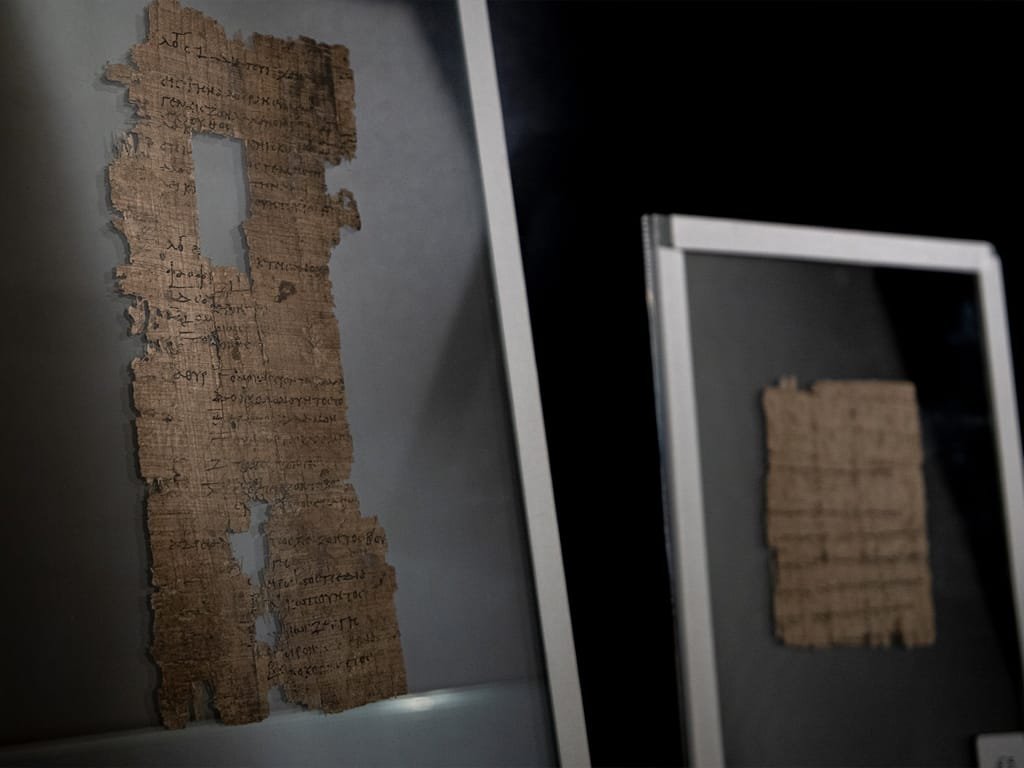
Room n.1 is entirely dedicated to Tebtýnis, a town in Lower Egypt in which Carlo Anti carried out his excavations between 1930 and 1936. The necklaces and ornaments on display are datable between the New Kingdom (between half and end of the second millennium B.C.) and the Roman age and were made largely in faïence, a term used to indicate a glassy material consisting of a silica core and a vitreous surface layer. From of the excavations in the ancient town of Tebtýnis are also some plaster casts from original sculptures of the Greek-Roman period: among these casts you can distinguish in the middle of the showcase the head of Soknebtýnis, the crocodile god, represented here in human shapes. Exceptional is a group of papyri in the right portion of the showcase, found in the Anti’s excavations: they are mostly datable between the middle Hellenistic age and the Roman imperial age (from III-II cent. B.C. to II-III cent. A.D.): still under study, they are on display in a small part for conservative reasons.
The small showcase on the side of the room houses an exceptionally rare object, one of the very few Pan flutes preserved from antiquity until today. Made with marsh reeds between the sixth and eighth centuries A.D., it certainly comes from Egypt, although it is not certain whether it was found in the excavations of Tebtýnis or recovered on the antiques market by Anti.
On the other side of the corridor, in room n.2, a fragment of bas-relief engraved and then overpainted on a limestone slab stands out in the middle of the showcase. It probably depicts an official of the Middle Kingdom (between the end of the IIIrd millennium B.C. and the XVIIth century B.C.); dating back to the Ptolemaic era (332-30 B.C.) are a fragment of funerary stela from Akhmìm and a pink granite statuette depicting a pharaoh. To the Late Period (672- 332 B.C.) belongs a group of small bronze statuettes, votive objects depicting deities such as Isis, Osiris, Nefertum and Ptah.
The Egyptian tradition also persisted in the Hellenistic and Roman ages and it is attested by some votive statuettes datable within the third century A.D. and depicting deities such as Apis, the bull god, and Harpocràtes, son of Isis and Osiris, as well as some Roman lamp handles decorated with Egyptianizing themes connected to Isiac cults, including an Isis enthroned nursing the little Harpocrates/Horus. Of importance is also a marble head of Jupiter Serapis: recovered in the excavations of the port of Roman Padua, it documents the spread of Alexandrian cults in Patavium, the ancient name of Padua, in the Roman Imperial period.
Among the most represented artifacts in the Egyptian collection of the museum there are the ushàbty, mummiform statuettes of small size, which were part of the funerary objects. The ushàbty on display, dated between the end of IInd- beginning of the Ist millennium B.C. and the half of IVth cent. B.C., have inscriptions that often bear the name of the deceased and are mainly made of faïence. The great diffusion of the ushabty and the fact they were particularly representative of the Egyptian culture have led to the creation of imitations, of which some specimens are preserved in the Museum, made of terracotta and often characterized by the presence of meaningless cartouches. These artifacts can be dated back to the late Roman and the Coptic period and then up to the modern and contemporary age, when these items were placed on the antiques market with fraudulent purposes. In any case today these fakes are important testimony of the so-called "Egyptomania", prevailing between the nineteenth and twentieth centuries of our era.
Made of faïence there is also a balsamary shaped as a hedgehog, missing the mouth and the handle: it is a typology probably produced in Naucratis (about 80 km south-east of Alexandria) starting from the sixth century B.C. It had a great diffusion in the Mediterranean area where it has been found in funerary contexts of Greek, Etruscan and Phoenician-Punic culture.
The exhibition of Egyptian materials ends with finds pertaining to the late Roman and Coptic periods, including: a so-called "frog" lamp, produced exclusively in Egypt until the sixth century A.D. and two fragments of San Menas’ ampoules, a martyr to whom the production of this particular devotional ware is found in various contexts of the Mediterranean.
From the Mediterranean area and precisely from Cyprus are also exhibited in the same showcase some objects of that island, including ceramics ranging from the beginning of the second millennium to the seventh century B.C.