Trascrizione
Welcome to the Museum of Archaeological Sciences and Art. A small yet extraordinary museum, due to the creative genius of the Italian architect Gio Ponti who designed the entire structure of Palazzo Liviano, and who paid great care and strong attention to detail in creating this unique exhibition space.
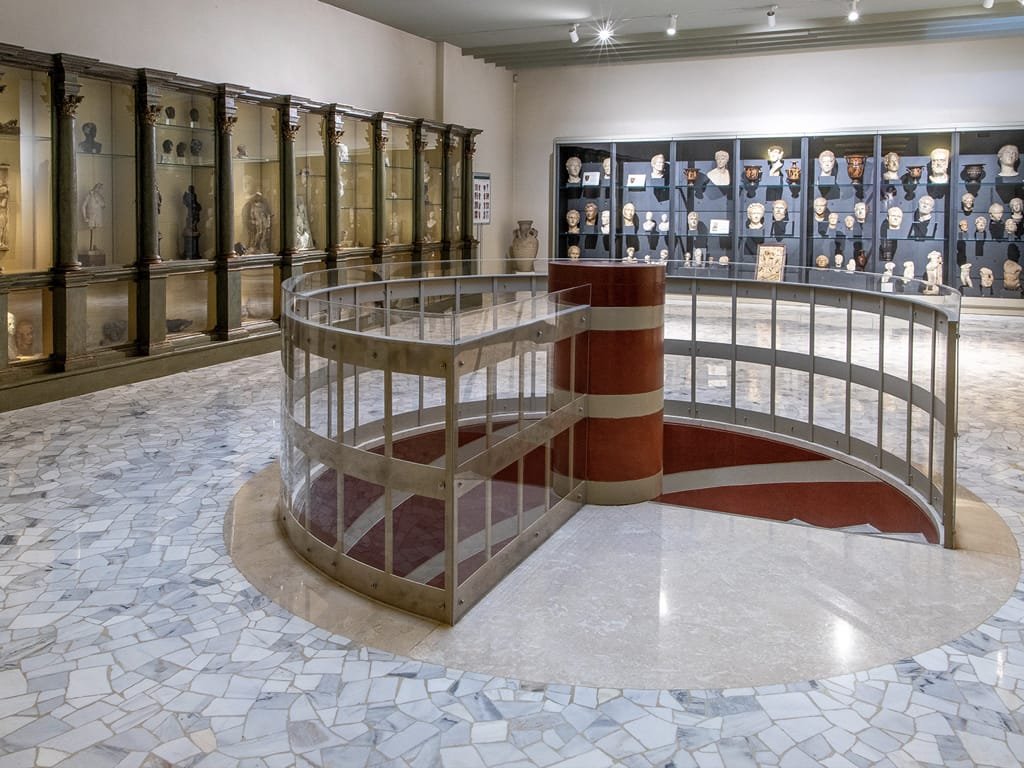
The entrance to the museum is through a spiral staircase, one of the distinctive features of Gio Ponti’s architecture, illuminated by a large skylight in the ceiling. Reaching the top of the staircase, you will find yourself in the museum’s first room and precisely at the centre of the exhibition. The open space allows your eyes to gaze without obstructions, the museum continues and ends through the second curved element, red like the staircase, on the opposite end of the museum.
The first room displays the collection of the jurist and humanist Marco Mantova Benavides who lived in Padua between 1489 and 1582. The objects of art and antiquities on display are those that Antonio Vallisneri, professor at the University of Padua, bought at the beginning of the eighteenth century from the last Mantova Benavides’ heir. Subsequently, his son Antonio Junior donated the collections to the University of Padua in 1733, their patronage made it possible to avoid the complete geographical dispersion of the Mantova Benavides Collection. The Vallisneri collection also became of exceptional importance as it gave rise to the first university museum in Padua, laying the foundation for future university museums.
As you leave the staircase behind and come upon the first room, you will encounter exceptional important pieces of artwork on your right. Here, you will find the cast of the head of the commander Erasmo da Narni, best known as Gattamelata, used for the bronze statue made by Donatello and located in the churchyard of Basilica of St. Anthony in Padua, which dates back to 1453. Next, we come across two models: the allegorical figure of Architecture by Alessandro Vittoria and the allegorical figure of Wisdom by Bartolomeo Ammannati, the latter model for the allegories found at the base of Marco Mantova Benavìdes’s tomb in the church of Saints John and James near the Eremitani convent in Padua.
After the three works find a bookcase cabinet, also attributed to Bartolomeo Ammannati, inside which you can see both modern sculptures, dated between the XVth and XVIth centuries, and ancient items: they all are probably working materials from workshops of artists of that time. Notice a St. John the Baptist from the Lombardos’ workshop, two terracotta statuettes of Venetian school, a statuette of Apollo attributed to Girolamo Campagna. Among the ancient sculptures: a fragment of a sarcophagus, dated to the IIIrd cent. A.D. , with the myth of Proserpina, at n. 34 on display.
Continuing to your right, a second showcase presents a series of portraits and vases in the upper shelf: it remembers the original arrangement of these works in the private museum of Mantova Benavides in the XVIth century. A virtual reconstruction of it can be found on the left of the showcase. Among the vases, the first two from the left are Renaissance vases that imitate the shapes of ancient vases but have modern iconography. More consistent are the ancient vases, all dated within fourth century B.C. They belong to several different Magna Graecia productions, with prevalence for the Apulian ware. Most of them are craters, vases with a wide mouth used to mix wine. Observe in particular the Lucanian crater with Orpheus and Eurydice at n. 37 on display and the Apulian crater with a Dionysian scene, at n. 44 on display.
In the same showcase, the Renaissance and ancient sculptures stand side by side. The portraits higher up and also those on the intermediate shelves depict characters from Roman history, especially emperors. Among them Augustus at n.14 on display, Nero at n.29 on display, Vitellius at n.30 on display, Domitian at n.40 on display, Commodus at nn. 43 and 47 on display, Caracalla at nn. 56 and 57 on display. The sculptures on the lower shelves largely represent ancient mythological characters and deities. The last segment on the right side of the showcase is also reserved for deities where you can see an Hellenistic replica of the head of Eros from an original bronze by Lysippus (IV a.C.) at n. 64 on display, and on the sides two female heads (one is supposed to be an Aphrodite). On the shelf below a statuette with drapery.
After the showcase, continue to the right and after a fifteenth century pillar, meet the major ancient sculpture displayed in three niches: in the first two are Greek works of the fourth century B.C. from Attica, they are: a fragment of funerary stele and a votive statuette of the goddess Athena. They are an important testimony of the early presence of classical Greek art in the collections of the Venetian Republic, compared to the majority of Italian and European states that knew that art much later. The last niche exhibits an elegant votive statuette of the first century A.D., found in Padua.