Trascrizione
Crossing the Camera dei Cavalli, we enter the Troia apartments, the state residence of Federico II Gonzaga, who became Duke of Mantua in 1530. The works were directed by Giulio Romano, who remodelled Federico II’s bachelor apartments in 1536–9, converting them into an articulated sequence of salons and studies, decorated with historical and mythological themes celebrating the sovereignty of the new duke.
The display was largely made up of movable works, which integrated the wall decoration still visible today. This is the case of the study on the left, the Camerino dei Cesari, which housed the series of portraits of Roman emperors painted by Titian, extolling their military virtues and now seen in copies of that period. And also “antique-style” busts of famous leaders sculpted for the Camera delle Teste but now lost.
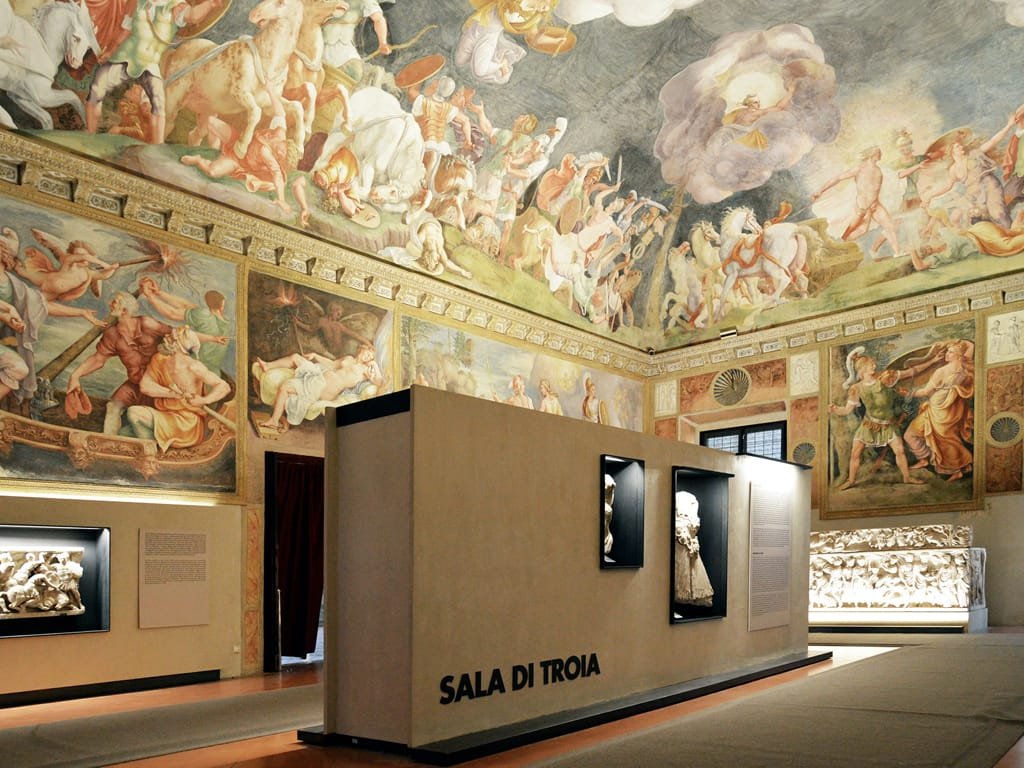
Continuing across the apartments we reach the Sala di Troia, the most prestigious of the rooms, striking for its single continuous fresco decoration narrating various episodes of the war between Greeks and Trojans, inspired by Homer’s Iliad and supplemented by other sources. Many artists worked here under the constant supervision of Giulio Romano, including Fermo Ghisoni and Rinaldo Mantovano, the same artists who had undertaken decoration of the suburban Villa del Te a few years earlier.
If it is open, a visit to the adjacent Loggia dei Marmi is worthwhile. Its name derives from the ancient marbles of the ducal collection that were placed here. The space became an outright gallery with the addition of an extension at the time of Guglielmo Gonzaga. It is also known as the Galleria dei Mesi for the stucco figures alluding to the months of the year and with the signs of the zodiac on the main walls.