Trascrizione
Welcome to Palazzo Ducale.
Our tour lasts about ninety minutes and will introduce you to leading figures in Italian and international history, and real masterpieces of art and architecture.
We selected a few of these for you, like Andrea Mantegna’s masterwork, the Camera degli Sposi; Pisanello’s mural cycle; paintings by Pieter Paul Rubens and Domenico Fetti; tapestries designed by Raphael.
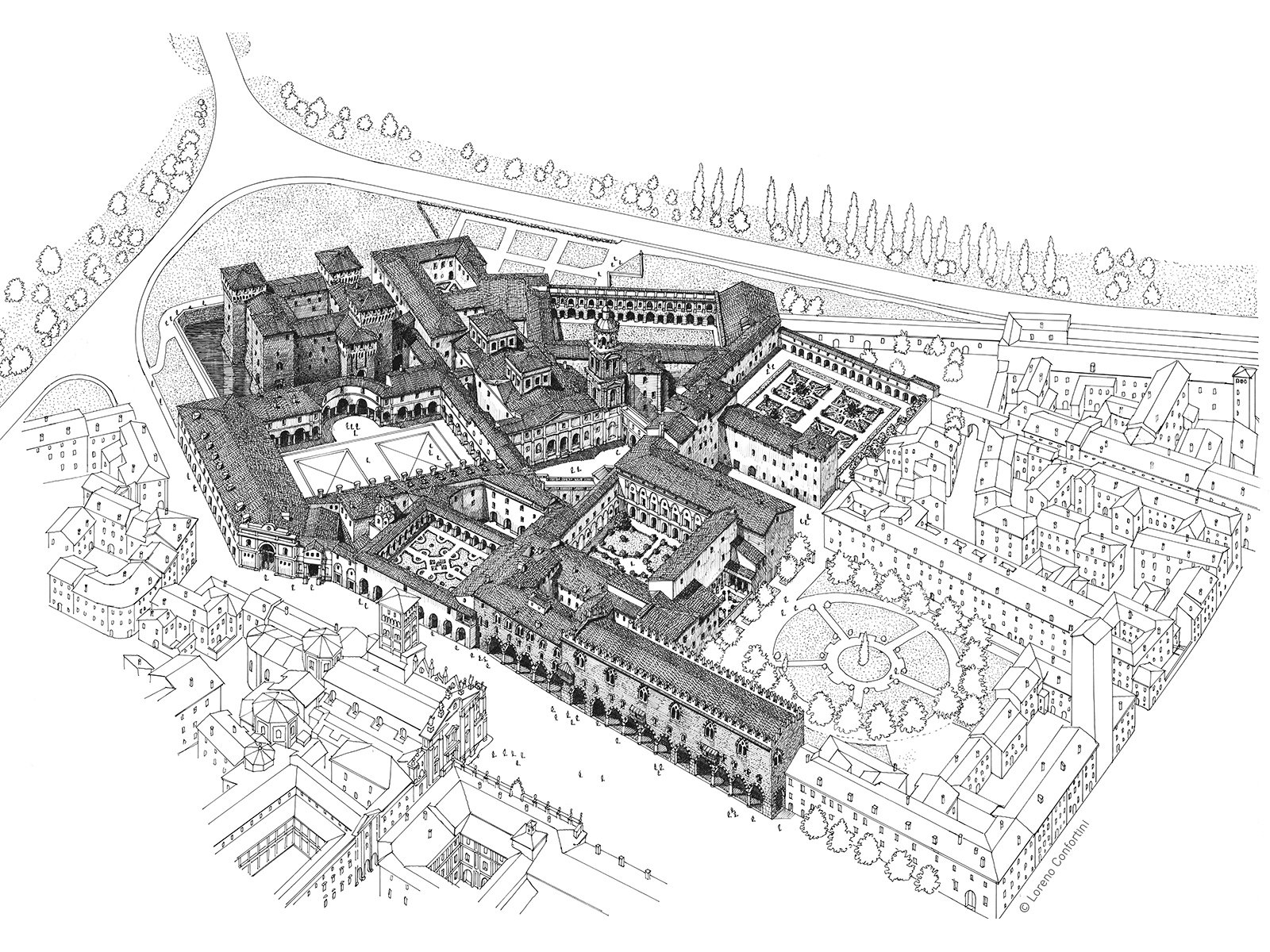
Palazzo Ducale is enormous. A document dated 1876 lists: “45 salons, 500 rooms, 4 gardens, 22 courtyards, 4 stables, 45 basements, 7 towers, a church with seating, a theatre.”
In sum, a maze of buildings, courtyards and gardens covering about 34,000 square metres.
For centuries Mantua remained a small city, with a significant Etruscan history and famed for being the birthplace of Virgil. After the year 1000, during the reign of Matilda of Tuscany, Mantua was a key player in developing the municipal autonomy that changed the face of Italy. In 1272, the Bonacolsi family established hereditary rule and commissioned some of the buildings in this complex. Nonetheless, the history of Palazzo Ducale coincides in the main with the fortunes of the Gonzaga family, who ruled Mantua from 1328 to 1707.
It is still possible to see signs of the eighteenth-century Habsburg rule of Mantua, lasting until 1866, when the city became part of the Kingdom of Italy.
In 1887, the immense palace was opened to the public as a museum. The buildings facing onto Piazza Sordello are just two of the many that make up this marvel of architecture.