In this room, a selection of precious objects used throughout the centuries in liturgical celebrations in the San Vigilio Cathedral is gathered. Crosses and chalices, ciboria and ostensories for the consecrated hosts, and reliquaries were made, according to canonical prescriptions, in rare and precious materials so as to evoke divine light.
The main symbol of episcopal office is the crozier or "pastoral staff," a staff with a curved end that alludes to the power exercised by bishops as "shepherds of souls." Here you can see an elegant example dating back to the mid-15th century, probably made by a German silversmith passing through Trento for Prince Bishop Georg Hack, who is depicted kneeling at the centre of the crook.
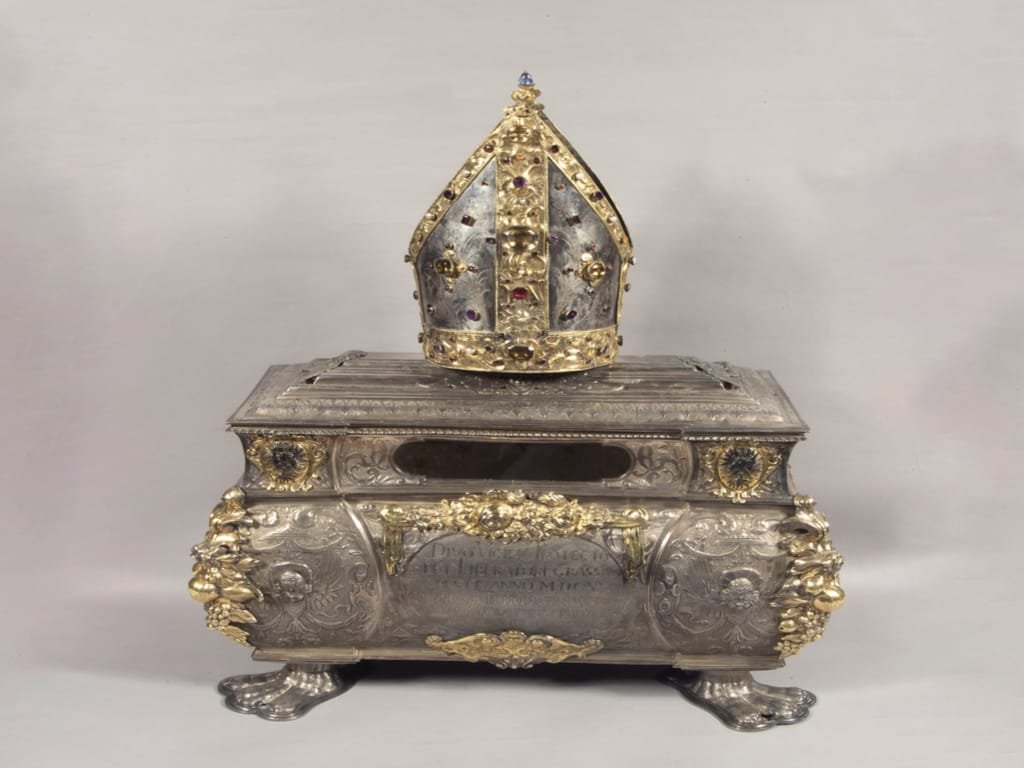
In the centre of the room is displayed the large processional urn of Saint Vigilius from 1632, which the city of Trento had made as an offering of thanks to the patron saint for his protection against the plague. The urn, updated according to Rococo taste in 1760, is used every year during the solemn procession in honour of Saint Vigilius on June 26.
At the back, a large showcase recalls the cabinet with painted doors where, in the sacristy of the Cathedral, the precious sacred vessels of the diocese were originally kept. Among these, the "arm" reliquary of Saint Vigilius stands out, an example of so-called "speaking" reliquaries, which reveal the part of the saint's body that they contain through their shape.
Trascrizione
In this room, a selection of precious objects used throughout the centuries in liturgical celebrations in the San Vigilio Cathedral is gathered. Crosses and chalices, ciboria and ostensories for the consecrated hosts, and reliquaries were made, according to canonical prescriptions, in rare and precious materials so as to evoke divine light.
The main symbol of episcopal office is the crozier or "pastoral staff," a staff with a curved end that alludes to the power exercised by bishops as "shepherds of souls." Here you can see an elegant example dating back to the mid-15th century, probably made by a German silversmith passing through Trento for Prince Bishop Georg Hack, who is depicted kneeling at the centre of the crook.
Displayed in the centre of the room is the large processional urn of Saint Vigilius from 1632, which the city of Trento had made as an offering of thanks to the patron saint for his protection against the plague. The urn, updated according to Rococo taste in 1760, is used every year during the solemn procession in honour of Saint Vigilius on June 26.
At the back, a large showcase recalls the cabinet with painted doors where, in the sacristy of the Cathedral, the precious sacred vessels of the diocese were originally kept. Among these, the "arm" reliquary of Saint Vigilius stands out, an example of so-called "speaking" reliquaries, which reveal the part of the saint's body that they contain through their shape.